
Quantum computing isn’t a faster version of your laptop.
It won’t make your games run smoother. It won’t make your phone charge faster. It won’t replace the computer on your desk.
While there is a myth that quantum computers will one day replace normal computers, it is wrong. For everyday things, such as watching videos, chatting with friends, doing homework, etc., a normal computer will stay the better tool.
A quantum computer is a completely different kind of machine. It is built to solve a few very hard puzzles. Some of these puzzles would take a normal computer billions of years. A big enough quantum computer could solve them in hours.
Note that one of those hard puzzles is the one that keeps the internet safe. This is what makes quantum computing a cybersecurity story, and not only a science story.
In this post, we will see what quantum computing is, how it works, when it will arrive, what it changes, what it means for security companies, which industries it will affect, what happens to crypto and AI, and what you can do to stay safe.
What is quantum computing?
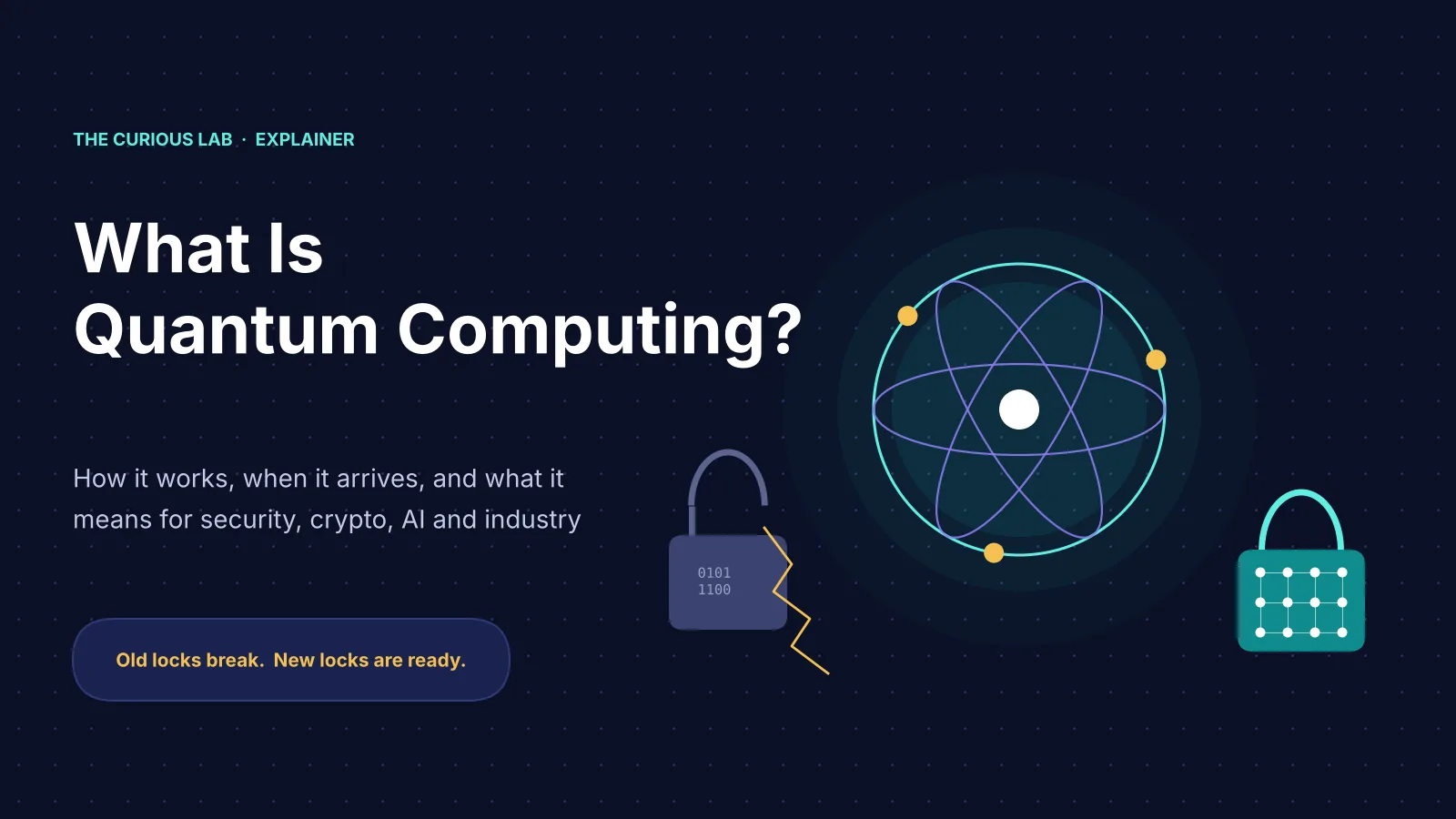
Quantum computing is a new kind of computing that uses the strange rules of the very tiny world, the world of atoms, to solve problems.
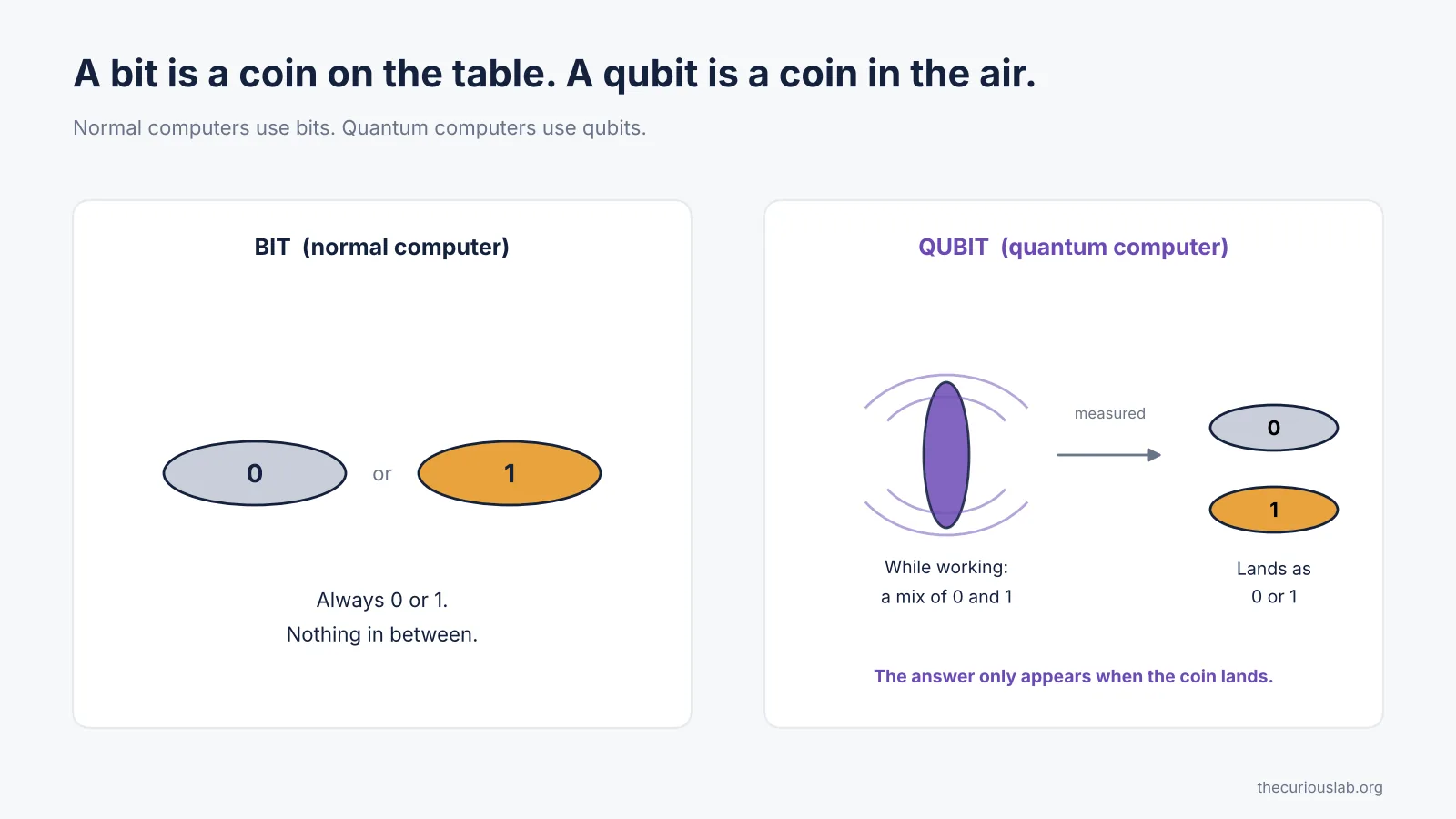
Every computer you have used so far works with bits. A bit is like a light switch. It is either off (0) or on (1). Your photos, songs and messages are all stored as long rows of these zeros and ones.
A quantum computer works with qubits. A qubit can also be 0 or 1. But while it is working, it can be a mix of both at the same time.
It is like a coin.
A bit is a coin lying flat on the table. It is heads or tails. Nothing in between.
A qubit is a coin spinning in the air. While it spins, it is not heads and not tails. It is a bit of both. Only when it lands do you see one side.
Now we’ll look at why this matters.
Say, for example, you have a giant key ring with a trillion keys, and only one of them opens a lock.
A normal computer tries key 1, then key 2, then key 3. It is very fast, but it still tries the keys one after another. With a trillion keys, that takes a long time.
A quantum computer works differently. It doesn’t try the keys one by one. It is set up so that the wrong keys cancel each other out, and the right key stands out. At the end, the right key is the one most likely to be left.
So, a normal computer finds the answer by checking every option. A quantum computer finds the answer by making the wrong options disappear.
Note that this trick only works on certain kinds of puzzles. For most normal jobs, a quantum computer is not faster at all.
How does quantum computing work?
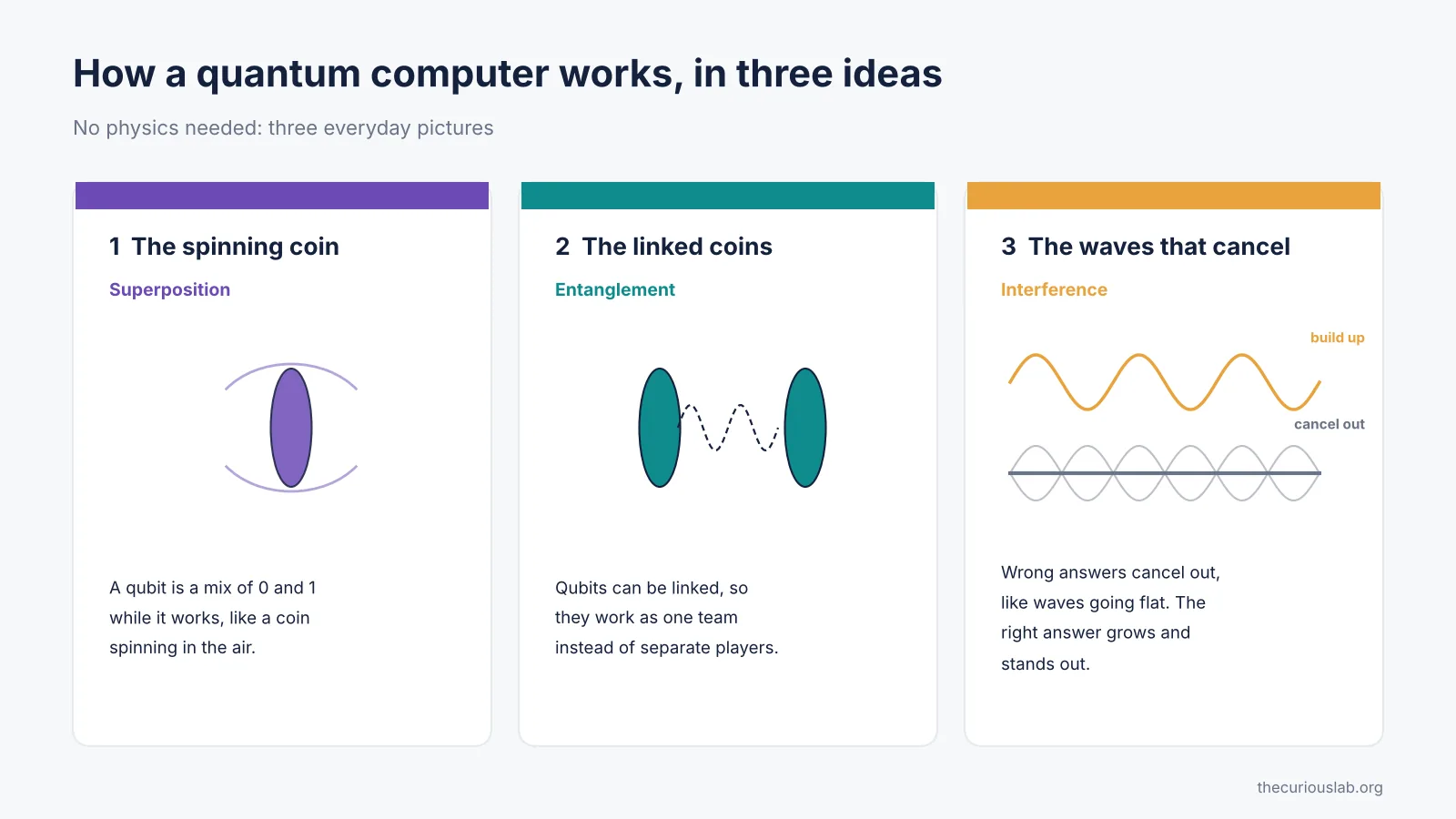
You don’t need to know any science for this part. A quantum computer depends on three simple ideas. We will explain each one with an everyday picture.
Idea 1 — The spinning coin
As mentioned earlier, a qubit is like a spinning coin. It can be a mix of 0 and 1 while it works. Scientists call this superposition.
The more coins you spin together, the more combinations they cover. Two coins cover 4 combinations. Ten coins cover more than 1,000. Three hundred coins cover more combinations than there are atoms in the whole universe.
This is what gives a quantum computer so much room to work.
Idea 2 — The linked coins
Qubits can also be linked together. When two qubits are linked, what happens to one is connected to what happens to the other, even if they are apart. Scientists call this entanglement.
Basically, linked qubits work as one team instead of as separate players.
Idea 3 — The waves that cancel
This is the idea behind the key ring example.
Think of waves in a swimming pool. When two waves rise together, they make a bigger wave. When one wave goes up just as another goes down, they cancel out, and the water goes flat.
A quantum computer is set up the same way. The wrong answers are made to cancel each other out, like waves going flat. The right answer is made to grow, like waves rising together.
Why are quantum computers so hard to build?
Qubits are extremely delicate, like soap bubbles. A little heat, a small shake or a tiny signal can pop them. When that happens, the qubit makes a mistake.
To protect them, many quantum computers are kept in special fridges that are colder than outer space. Even then, qubits still make too many mistakes for the big jobs.
The fix is teamwork. Many delicate qubits work together to act as one strong, reliable qubit. It is like a group of friends writing down the same message. If one of them gets a word wrong, the others can correct it.
So, the real race is not about who has the most qubits. It is about who can make qubits that don’t make mistakes.
When can we expect quantum computers?
Small quantum computers already exist. Scientists use them for experiments. But the big one, the one strong enough to break internet security, is not here yet.
Here is how far things have come.
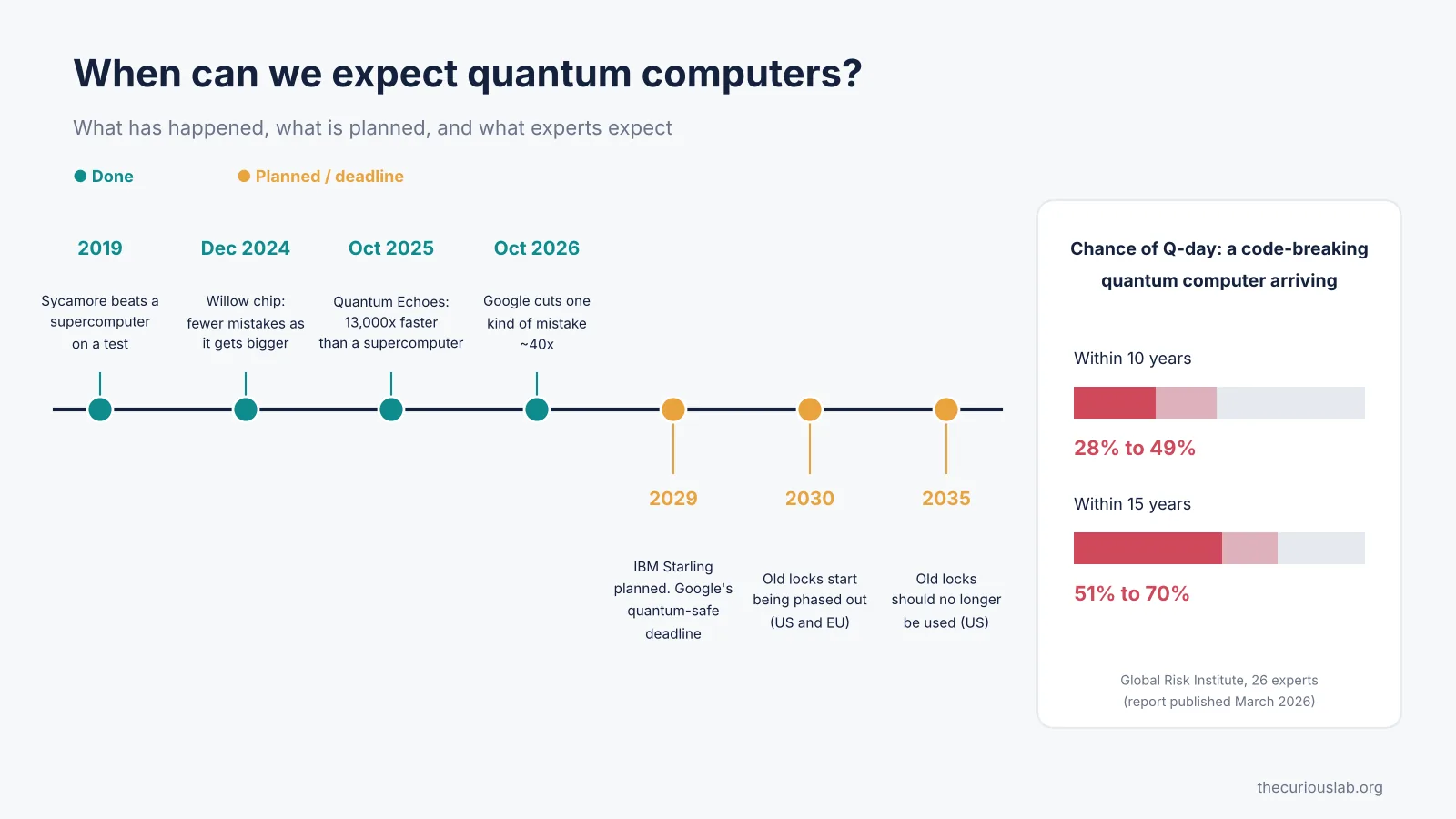
- 2019: Google’s quantum chip finished a test puzzle that Google said would take a supercomputer thousands of years.
- December 2024: Google showed its Willow chip. For the first time, its qubits made fewer mistakes as more of them were added. This is a big step toward a useful machine.
- October 2025: Google ran a test about 13,000 times faster than a supercomputer, and this time the answer could be checked.
- October 2026: Google showed another way to cut down qubit mistakes, about 40 times fewer for one important step.
And here is what is planned.
- 2029: IBM plans to finish a quantum computer called Starling that can keep working correctly even when some of its qubits make mistakes.
- 2029: Google has set itself a deadline to switch its own systems to new, quantum-safe locks.
The day a quantum computer becomes strong enough to break today’s internet security has a name. It is called Q-day.
Nobody knows exactly when Q-day will come. Every year, the Global Risk Institute asks top experts to guess. In its report published in March 2026, 26 experts said:
- there is roughly a 1 in 4 to 1 in 2 chance (28% to 49%) of Q-day within the next 10 years
- there is more than a 1 in 2 chance (51% to 70%) within the next 15 years
Note that these are guesses, not promises. But they are high enough that governments and big companies are already preparing.
Basically, most experts expect Q-day sometime in the 2030s, and it could come sooner.
How will quantum computing affect current technology?
Most of your technology won’t change at all. Your phone, laptop and games will keep working the same way.
Quantum computers are huge and need special fridges, so they won’t be in your home. They will live in big data centers, and companies will rent time on them over the internet.
The big change is in something you never see: encryption.
Encryption means scrambling information so that only the right person can read it. It is like a lock on a diary. Only the person with the key can open it.
Encryption works every time you:
- see the little padlock next to a website address
- log in to an app or a bank
- send a message on WhatsApp
- update your phone
Today’s locks are safe because a normal computer would need billions of years to break them. A big enough quantum computer could break some of them in hours or days.
Here is what happens to the different kinds of locks.
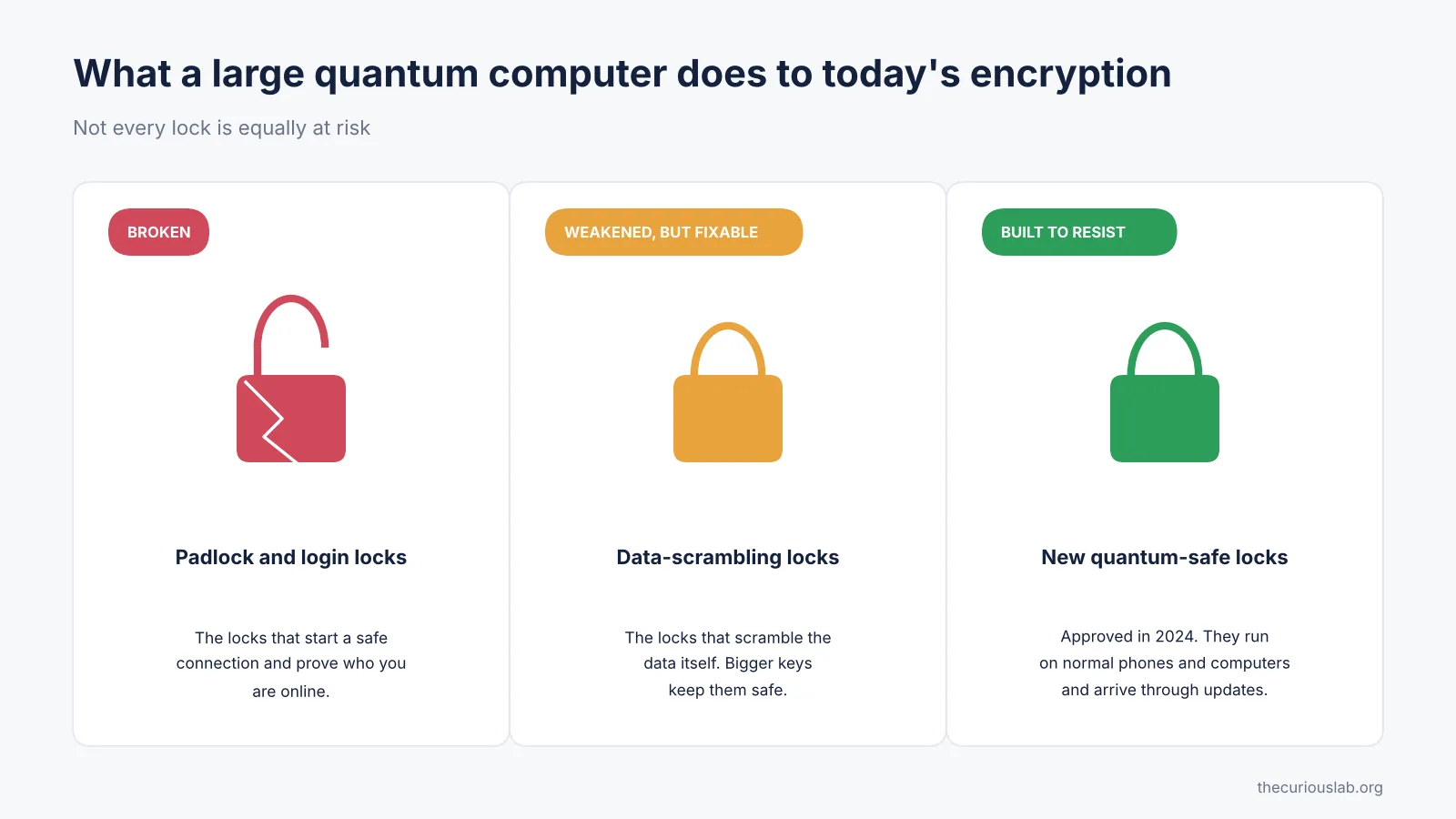
Broken: The locks that start a safe connection and prove who you are online. These are the ones behind the browser padlock and many logins.
Weakened, but fixable: The locks that scramble the data itself. A quantum computer can only weaken these a little. Making the keys bigger keeps them safe.
Built to resist: A new set of locks, called post-quantum cryptography, or quantum-safe encryption. These are built on puzzles that even quantum computers find hard. The US government’s standards agency, NIST, approved the first of these new locks in August 2024.
Note that the new locks run on normal computers and phones. You don’t need a quantum computer to use them. They arrive through ordinary software updates. In fact, most major web browsers already use them, and by late 2025, more than half of human web traffic going through Cloudflare, a company that handles a big part of the internet, was protected by them.
So, the real change is not new gadgets. It is the whole world quietly changing the locks on the internet before Q-day arrives.
What should cybersecurity companies expect?
For the security industry, the quantum problem has already started, even though Q-day hasn’t arrived yet.
The attack has already started: harvest now, decrypt later
An attacker doesn’t need a quantum computer today to cause damage later.
They can steal locked data now. They store it. They wait. When a strong quantum computer exists, they open it.
This is called harvest now, decrypt later.
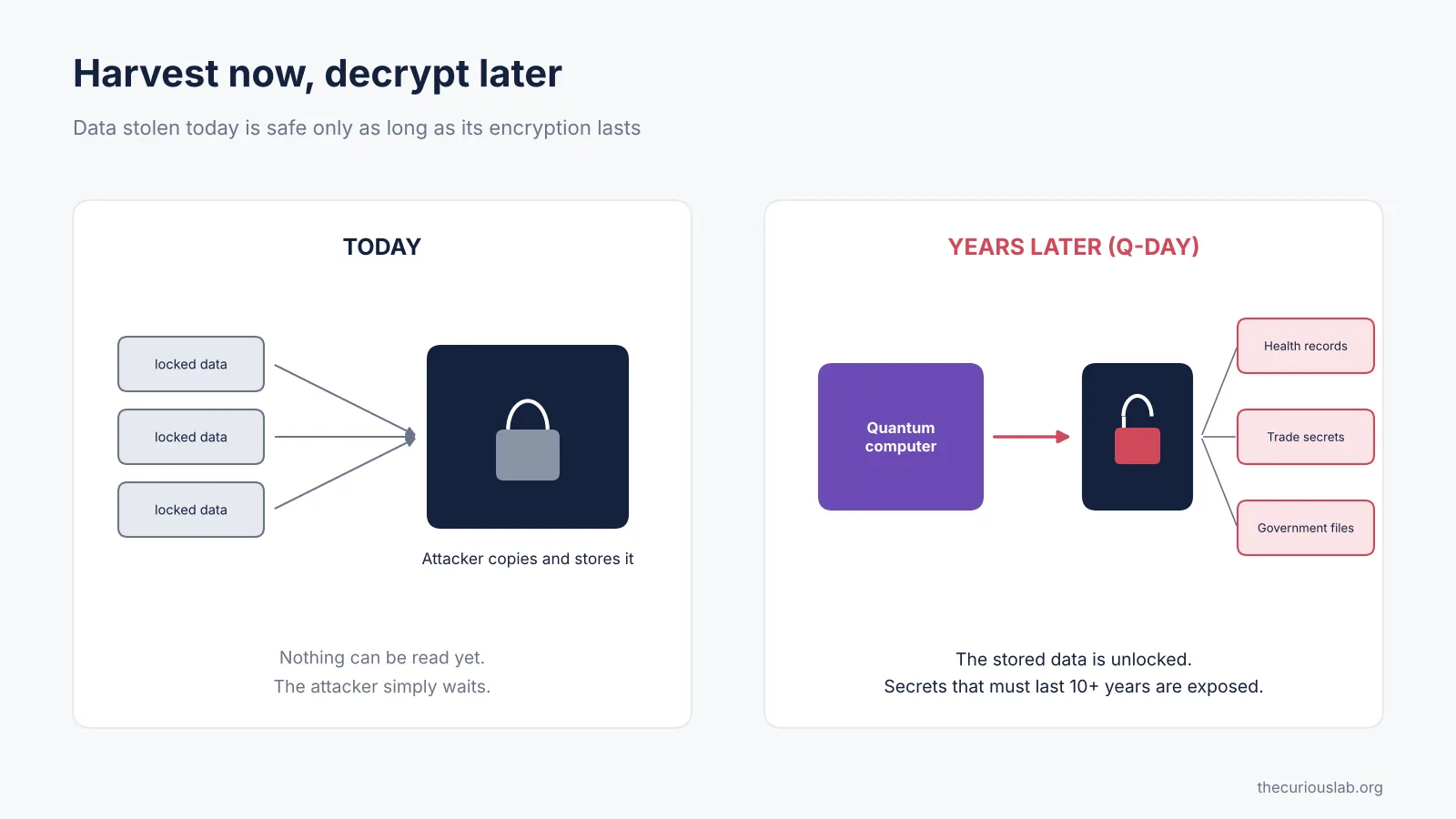
It is like someone taking photos of a locked diary today, knowing a master key will be invented in ten years.
Here is the difference from a normal data theft. In a normal theft, the attacker steals data they can read today. In harvest now, decrypt later, the attacker steals data they can only read in the future.
This matters for secrets that must stay secret for a long time, such as medical records, government files, company secrets, etc. In a 2026 survey by the security company DigiCert, 84% of IT and security leaders said they believe some of their locked data is already at risk from this.
Stolen data, locked or not, is often sold on hidden websites. We explained how stolen data is bought and sold in our post on dark web basics.
There are now deadlines
Governments have set dates for replacing the old locks.
- United States: The plan from NIST says the old locks should start being phased out after 2030 and should not be used at all after 2035.
- European Union: EU countries should move their most important systems to the new locks by the end of 2030, and as much of everything else as possible by the end of 2035.
Note that 2030 is not far away. Big companies have locks hidden in thousands of places, and replacing all of them takes years.
Most companies are not ready
The same DigiCert survey found that 87% of companies are planning or testing the new locks. But only 7% have actually switched most of their systems.
What security companies should expect
- Finding the locks: Most companies don’t know where all their locks are. The first big job is making a list.
- Using two locks at once: For the next few years, many systems will use an old lock and a new lock together. If one fails, the other still protects the data.
- Questions from customers: Customers will start asking security companies whether they are quantum-safe. Companies will need a clear answer.
- New jobs: Someone has to do all this work. This will create many new jobs. If you are thinking of a career in cybersecurity, our cybersecurity roadmap is a good place to start.
- Old tricks stay: Quantum computers won’t stop phishing, scams or weak passwords. Most attacks will still start the same way they do today, as we explained in our post on how cyberattacks work.
Remember, a strong quantum computer could also fake digital “signatures”. These are what prove that an app update is real or that a website is genuine. With fake signatures, an attacker could make a fake update look real. We showed how much a single breach can cost in our post on the IBM Cost of a Data Breach report.
Which industries will quantum computing affect the most?
Quantum computing will affect industries in two ways.
- Opportunity: Some industries will be able to do things they couldn’t do before, such as designing new medicines faster.
- Security risk: Some industries hold secrets that must stay safe for many years, so they have the most to protect.
Many industries face both. Below is how we see the main sectors.
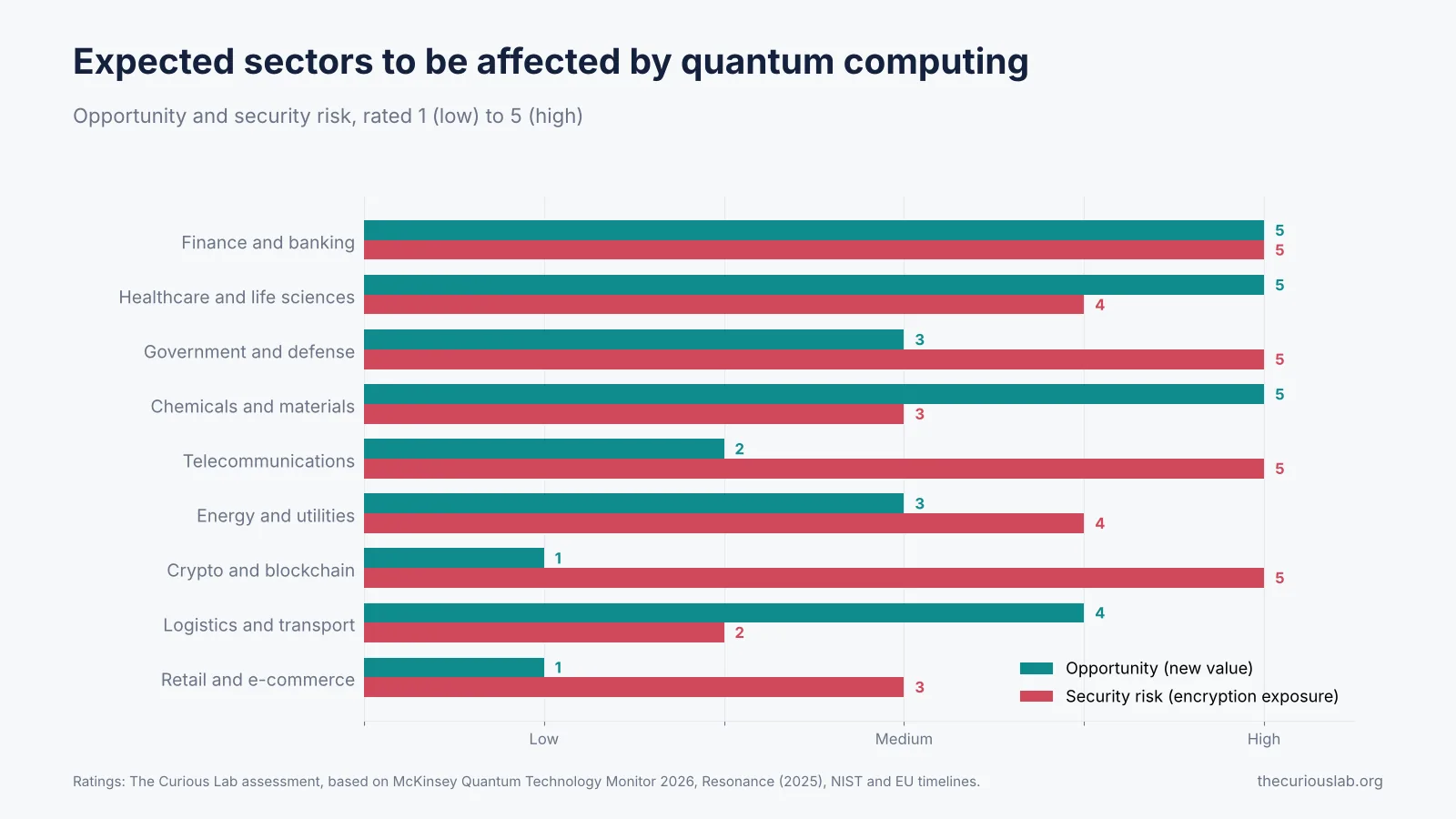
Banking and finance: Banks do a lot of hard math to manage money and catch fraud. Quantum computers could help with some of it. But banks also depend heavily on locks, so they have a lot of locks to replace.
Healthcare and medicine: Medicines are made of molecules, and molecules follow the same tiny-world rules that quantum computers use. We consider this to be the area where quantum computers could help the most. At the same time, health records stay private for a person’s whole life, which makes them a big target for harvest now, decrypt later.
Both banking and healthcare sit near the top of our graph. Both have a lot to gain, and both have a lot to protect.
Government and defense: Government secrets can stay secret for decades. This makes them the biggest target for data being stolen today and opened later.
Chemicals, materials and energy: Better batteries, cleaner fuels and stronger materials all depend on understanding molecules. Power grids also use old equipment that is hard to update with new locks.
Phone and internet companies: They carry everyone’s locked messages, so they have to upgrade a huge number of systems.
Delivery and transport: Planning the best routes for thousands of trucks or planes is a giant puzzle. Quantum computers may help solve it.
Crypto: This one has a special problem. We cover it in its own section below.
Shops and online stores: They will mostly feel the change through their payment companies upgrading their locks.
The money shows how big this is. The business advisory firm McKinsey estimates that quantum technology could create between $1.3 trillion and $2.7 trillion in value by 2035. In 2025 alone, quantum start-up companies raised $12.6 billion.
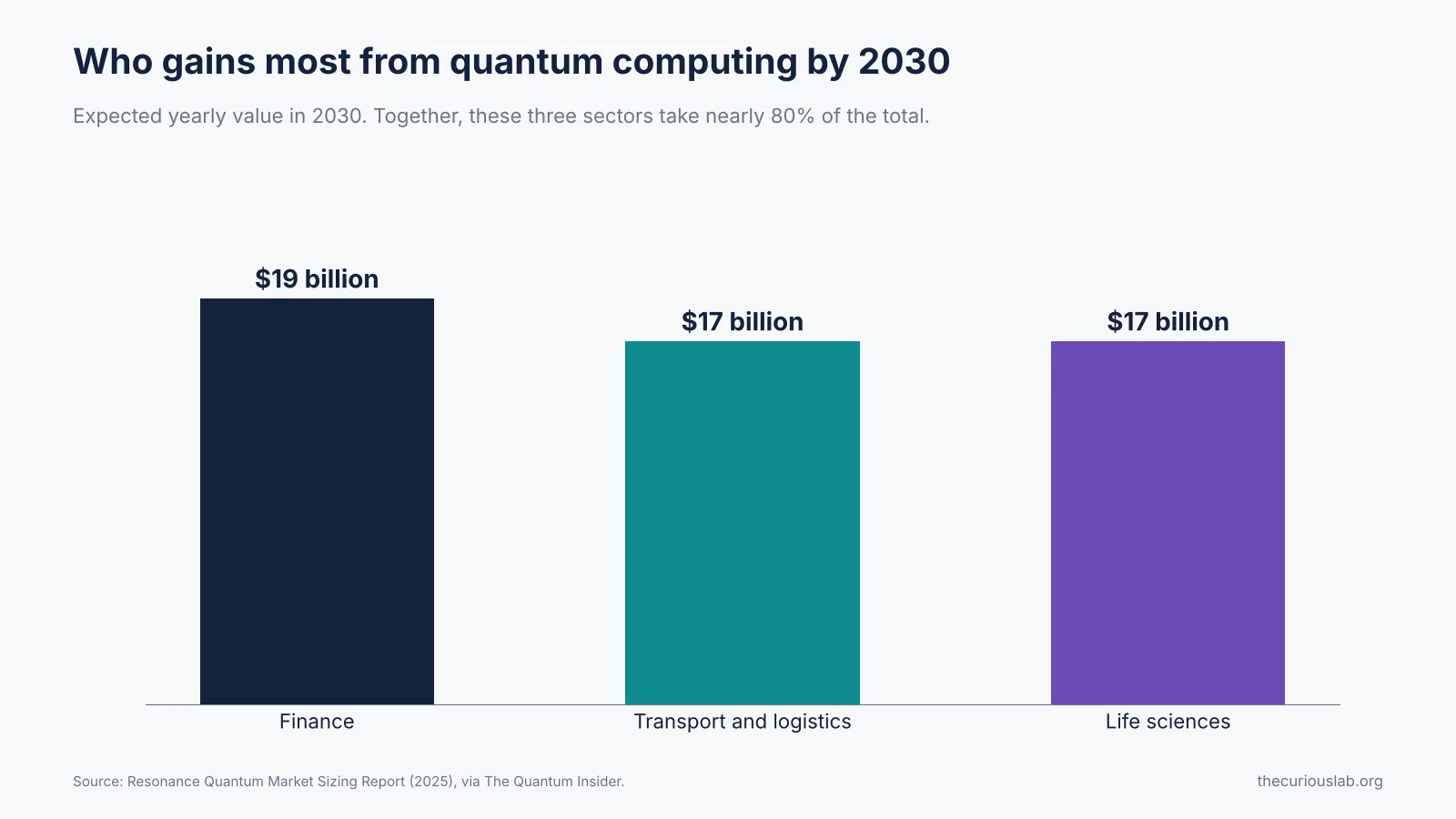
For the nearer future, a 2025 report by the research firm Resonance expects three sectors to get nearly 80% of the value from quantum computing in 2030.
How will quantum computing affect crypto?
Cryptocurrencies, such as Bitcoin, are protected by the same kind of locks that quantum computers can break.
Every crypto wallet has two parts.
- A private key. This is a secret password that lets you spend your coins. Only you should ever know it.
- A public key. This is a code that other people can see. It proves a payment really came from you.
Today, it is impossible to work out the secret password from the public code. A strong quantum computer could do it. Then an attacker could take the coins.
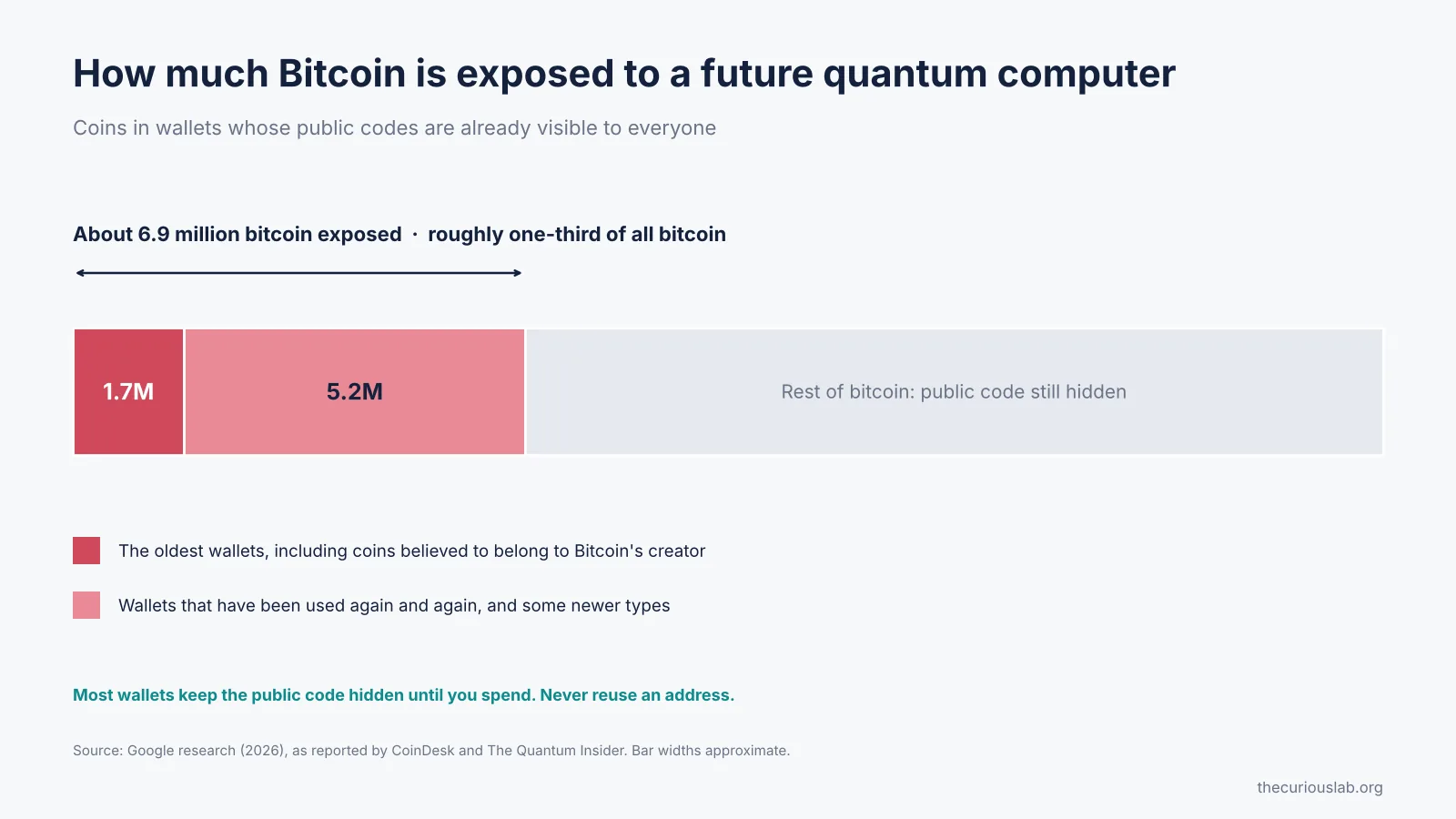
Note that most wallets keep the public code hidden until you spend from them. But some wallets have already shown their public code to everyone, such as very old Bitcoin wallets and wallets that have been used again and again.
In 2026, Google researchers said that about 6.9 million bitcoin, roughly one-third of all bitcoin, sits in wallets whose public codes are already visible. About 1.7 million of those are in the oldest wallets, including coins believed to belong to Satoshi Nakamoto, the unknown person who created Bitcoin.
The crypto world is working on a fix, but it is slow. A blockchain can only change when most of its community agrees.
- In February 2026, Bitcoin developers proposed a new type of wallet that is ready for quantum-safe locks.
- In October 2026, Coinbase, one of the biggest crypto companies, published its plan for moving Bitcoin to quantum-safe locks. It said the move will take years and should start now.
There is also a hard question nobody has answered yet. Some coins belong to people who have lost their keys or are no longer around. Those coins can’t be moved to safe wallets.
While there is a myth that quantum computers will “destroy the whole blockchain”, it is wrong. The blockchain itself is protected by a different kind of math that quantum computers can only weaken. The real risk is to individual wallets whose public codes are visible.
If you hold crypto, our free Crypto Wallet Safety Checker helps you check a wallet address for known risks today. Note that right now, crypto scams are a much bigger danger than quantum computers. The warning signs in our post on how to tell if someone is scamming you online matter most.
How will quantum computing affect AI?
Quantum computing and AI are two of the biggest technology stories right now, so people often mix them up. Here is what we can realistically expect.
AI is already helping quantum computers. In 2024, Google DeepMind built an AI called AlphaQubit that spots qubit mistakes better than older methods. Fewer mistakes means useful quantum computers arrive sooner.
Quantum computers won’t run chatbots. It is a myth that quantum computers will soon power apps like ChatGPT. AI needs to read huge amounts of data very fast. Normal AI chips are great at that. Quantum computers are slow at it.
They will work as a team. Quantum computers may help AI with a few special jobs, such as understanding molecules for new medicines. Basically, AI is good at finding patterns in data. Quantum computers are good at certain puzzles about nature. Together, they can do more than either one alone.
Both bring new security worries. AI is making scams and attacks more convincing today. Quantum computing could break locks in the future. We covered the AI side in our posts on how to prevent AI cyber attacks and will AI take over cybersecurity.
A real story: the number that keeps getting smaller
The easiest way to understand the quantum threat is to follow one number. It is the number of qubits that experts think a quantum computer would need to break one of the most common locks on the internet.
In 2012, experts estimated about 1 billion qubits. That sounded safe. Nobody could imagine building a billion qubits.
In 2019, two Google researchers, Craig Gidney and Martin Ekerå, found a smarter method. The estimate dropped to about 20 million qubits.
In 2025, Gidney found an even smarter method. The estimate dropped again, to fewer than 1 million qubits. Note that the machines didn’t change. Only the method got better.
In 2026, Google researchers did the same for the type of lock that protects Bitcoin. Their estimate was fewer than 500,000 qubits.
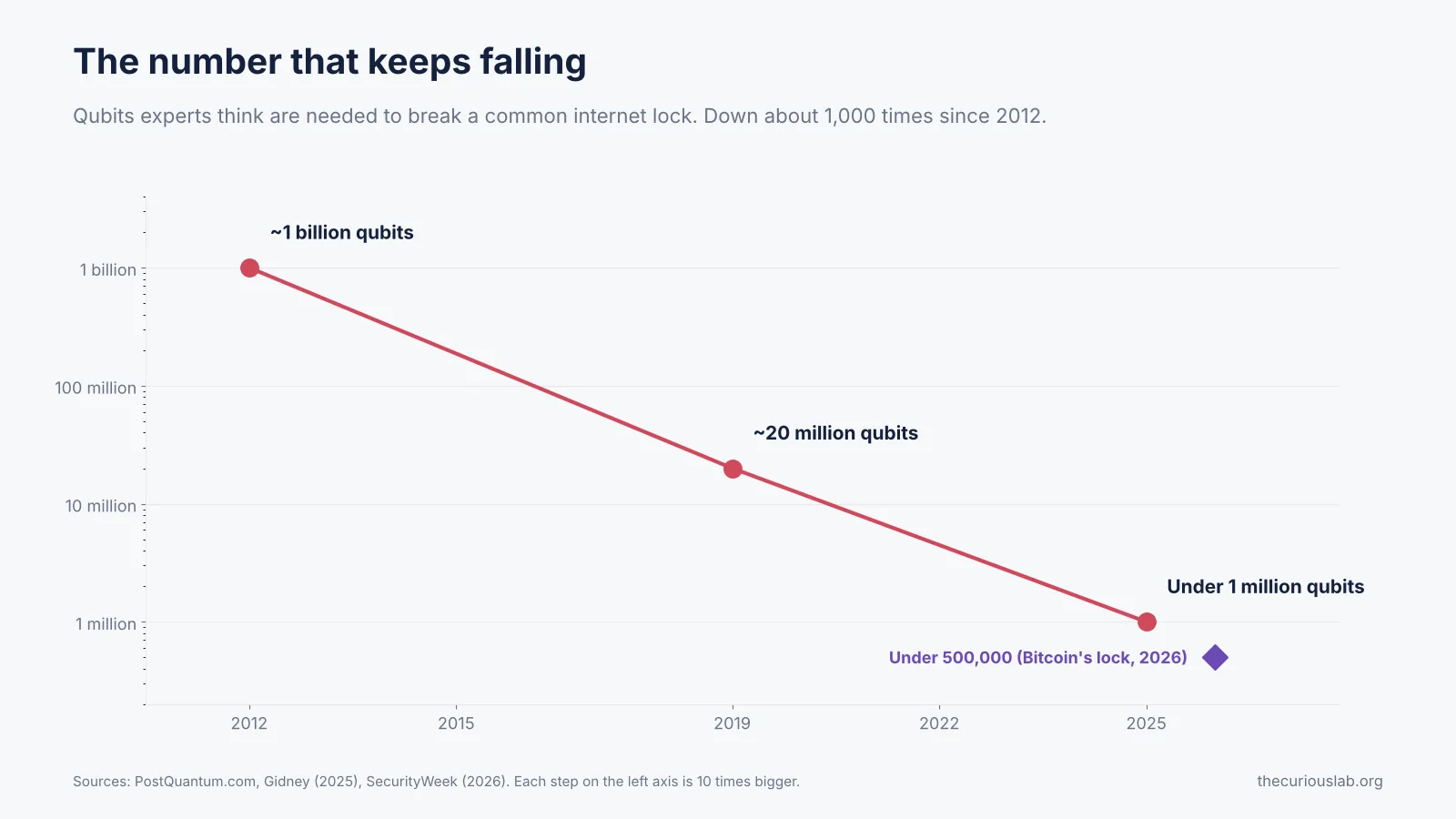
This story shows the most important fact about the quantum threat. Two things are happening at the same time. Quantum computers are getting bigger. And the number of qubits needed to break the locks keeps getting smaller.
It is like two people walking toward each other from opposite ends of a long road. Nobody knows exactly where they will meet, but they are getting closer every year.
What precautions should we take?
The good news is that the new locks already exist. The job now is putting them everywhere. Here is what to do, depending on who you are.
For businesses
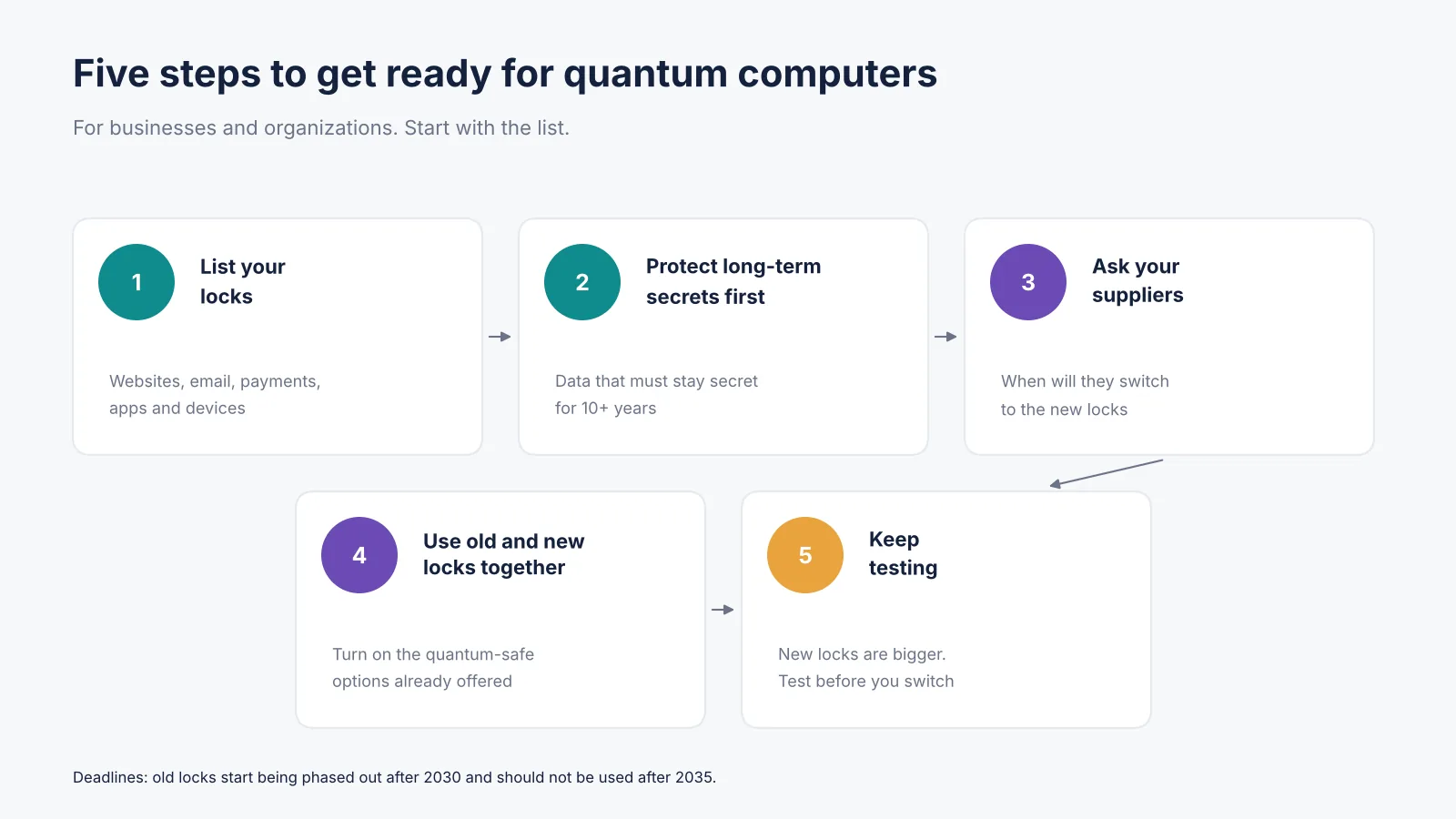
- List your locks. Find every place your company uses encryption, such as websites, email, payments, apps and devices.
- Protect long-term secrets first. Start with data that must stay secret for more than ten years, such as health, legal and customer data.
- Ask your suppliers. Much of your security comes from other companies. Ask each one when they will switch to the new locks.
- Use old and new locks together. Turn on the quantum-safe options that cloud services, browsers and VPNs now offer.
- Keep testing. The new locks are bigger, and some older systems may struggle with them. Test before you switch.
Note that none of this replaces the basics. Update your systems. Protect your logins. Train your team. A new lock doesn’t help if someone tricks you into handing over the key.
For everyone
You don’t need to buy anything or learn anything technical. Here is what helps.
- Keep your phone, laptop and apps updated. Updates are how the new locks reach you. We explained why updates matter in our post on how to protect your home computer.
- Use messaging apps that already have quantum-safe locks. For example, Apple’s iMessage and the Signal app have both added them.
- Use strong, different passwords and two-step verification. They protect you from today’s attacks. You can make a strong password with our free password generator.
- Watch for data breaches. If your data has already leaked, quantum computing doesn’t change that. Our Curious Lab Breach Index lists the breaches made public this year, and our post on what is identity theft explains what to do if your details are exposed.
For crypto holders
- Never reuse a crypto address. Use a new receiving address every time. Most modern wallets do this for you.
- Keep your wallet app updated, so you can move to quantum-safe wallets when they are ready.
- Only trust official news about upgrades.
- Never move your coins because of a message, email or video, however real it looks.
Scams to watch out for
Every big technology story brings new scams. Watch out for “quantum-proof” investments that promise easy money, fake “quantum wallet upgrades” that steal your coins, and fake apps that claim quantum protection.
We explained how these tricks work in our posts on what is baiting and what is phishing. If you get a link about a “quantum upgrade”, check it first with our free Link Safety Checker. If you have doubts, leave the website.
Final thoughts
Quantum computers won’t replace your laptop or your phone. But over time, they will help create new medicines, materials and technology, and they will force the whole world to change the locks that protect the internet.
Note that the danger doesn’t start on Q-day. It started the day attackers began stealing locked data to open later.
The good news is that the new locks are ready, and many of them already protect you without you noticing. The work now is to finish the switch before the 2030 and 2035 deadlines.
For you, the most useful step is the simplest one: keep everything updated. For businesses, the first step is to find where all their locks are.
If you are new to cybersecurity, start with our guide on cybersecurity basics for everyone.
We will update this post as new quantum computing milestones are announced.
Stay safe, stay alert!
Related posts from The Curious Lab
- Dark Web Basics: Tools, Links, How to Access
- How to Prevent AI Cyber Attacks? A Simple Guide for Everyone
- Will AI Take Over Cybersecurity? A Complete Analysis
- IBM Cost of a Data Breach Report
- How Cyberattacks Work
- What Is Identity Theft? How It Happens, Types, Signs and What to Do
- How to Tell If Someone Is Scamming You Online? Signs, Tests and Free Tools
- How Can You Protect Your Home Computer? A Simple Guide for Everyone
- What Is Email Spoofing?
- How Long Does It Take to Learn Cybersecurity? Cybersecurity Roadmap
- Understanding Cybersecurity Basics for Everyone
Free tools from The Curious Lab
- Crypto Wallet Safety Checker: check a wallet address for known risks before you send.
- Link Safety Checker: check a link before you open it.
- Password Generator: create a strong, random password in one click.
- Curious Lab Breach Index: see the data breaches made public this year.