
How to Tell If Someone Is Scamming You Online? Signs, Tests and Free Tools
A scammer online doesn’t look like a criminal.
Instead, the scammer looks like someone you can trust. They text you by mistake. They offer you an easy job. They sell you a phone at a good price. They become your friend and show you how they make money with crypto. Note that most of them stay polite and patient until the day they ask for money.
This is what makes it so hard to tell if someone is scamming you online. You can’t see the person, and almost everything you can see can be faked: the photo, the name, the company logo, the website, and even the voice.
But a scam is not random. Every online scam follows a script, and every script ends in the same place: you sending money, a code, or access. So, instead of trying to guess whether the person is real, you can watch the script. The signs show up there.
In this post, we will see why online scams are so common now, how a scam script works, how to identify a scammer from the signs at each stage, the most common scams and their tell-tale signs, simple tests you can run on anyone, free tools that help, and what to do if you have already paid.
No technical background is needed to understand this. We have written it for the common person, with basic technical details added along the way for cybersecurity enthusiasts.
Why is it so hard to tell if someone is scamming you online?
Online, the scammer controls everything you see.
In person, you can see a face, a shop, an office, or a car. Online, a profile photo can be stolen from a real person. A company website can be built in an afternoon. A screenshot of a bank balance can be edited. And now, as we covered in our post on how to prevent AI cyber attacks, AI can write perfect messages and copy a voice.
The numbers show how well this works. According to the US Federal Trade Commission (FTC), Americans reported 3 million fraud reports and $15.9 billion in losses in 2025. That is up from 2.6 million reports and just over $12 billion in 2024, and reported losses have risen by nearly 430% since 2020. The FTC also notes that the real losses are higher, because not every victim reports.
A few more FTC findings for 2025 explain where the danger is.
- Text messages were the most common way scammers first made contact.
- Social media caused the biggest losses. Nearly 30% of people who lost money said the scam started there, with $2.1 billion lost.
- Investment scams took the most money, $7.9 billion, about half of all reported losses.
- Imposter scams, where someone pretends to be a company, an official, or a person you know, were the most reported type, as they have been since 2020.
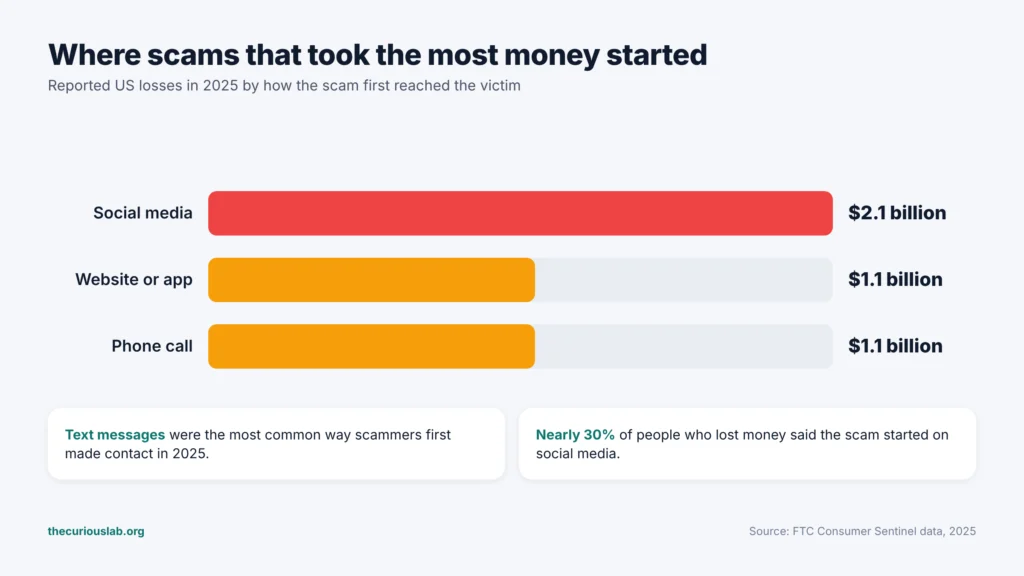
Reported US losses in 2025 by how the scam first reached the victim. Source: FTC Consumer Sentinel data.
There is one more reason it is hard. Many victims don’t realize it is happening. Since January 2024, the FBI has been contacting people who are in the middle of crypto investment scams, in an effort called Operation Level Up. By June 2025, it had notified 6,475 victims, and 77% of them did not know they were being scammed. The FBI has also said that most of these victims were between 30 and 60 years old and comfortable with technology.
Basically, being smart or careful is not enough. Knowing the script is what protects you.
How does an online scam work?
Most online scams, whatever the story, move through the same four stages. We call it the scam script.
- Contact: the scammer reaches you. A “wrong number” text, a friend request, a dating match, a job message, an ad, or a search result.
- Trust: the scammer builds a relationship or a reason to believe them. This can take five minutes or five months.
- The story: the scammer brings up a problem or a prize. An emergency, a debt, a fine, an investment, a job bonus, or a package on hold.
- The payment: the scammer asks for money, a code, personal details, or access to your device, usually in a way that is hard to reverse.
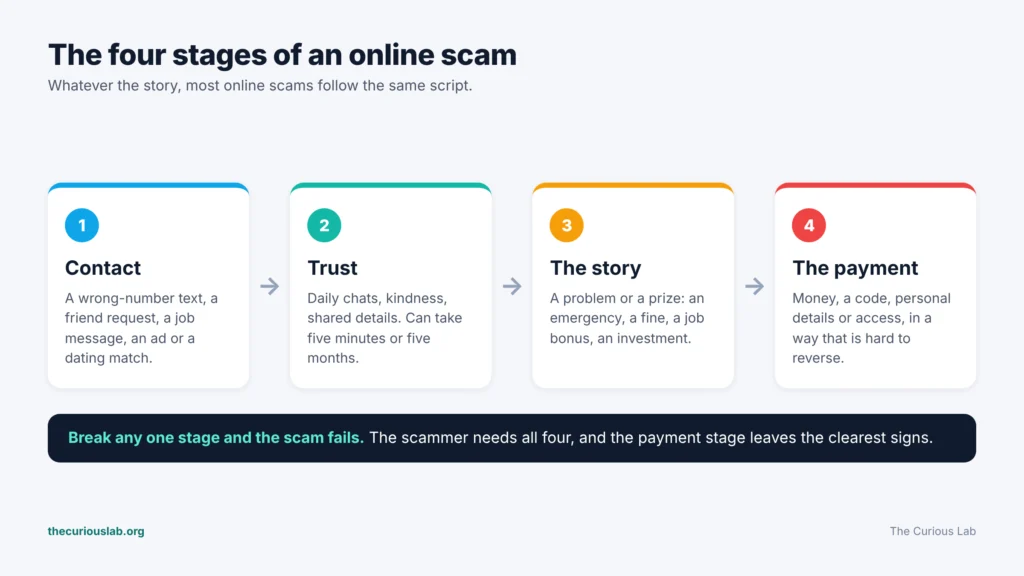
The four stages of a scam script. Every stage leaves signs, and the payment stage leaves the clearest ones.
Note that the scammer needs all four stages. If you stop the script at any one of them, the scam fails. This is the same idea we saw in our post on baiting: break one link and the attack breaks.
The FTC describes the same pattern in its four signs of a scam: scammers pretend to be from an organization you know, say there is a problem or a prize, pressure you to act immediately, and tell you to pay in a specific way. Those four signs map almost exactly onto the stages above.
How to identify a scammer: the signs at each stage
Here are the signs of a scammer, grouped by where they appear in the script. One sign alone doesn’t always mean a scam. Several signs together almost always do.
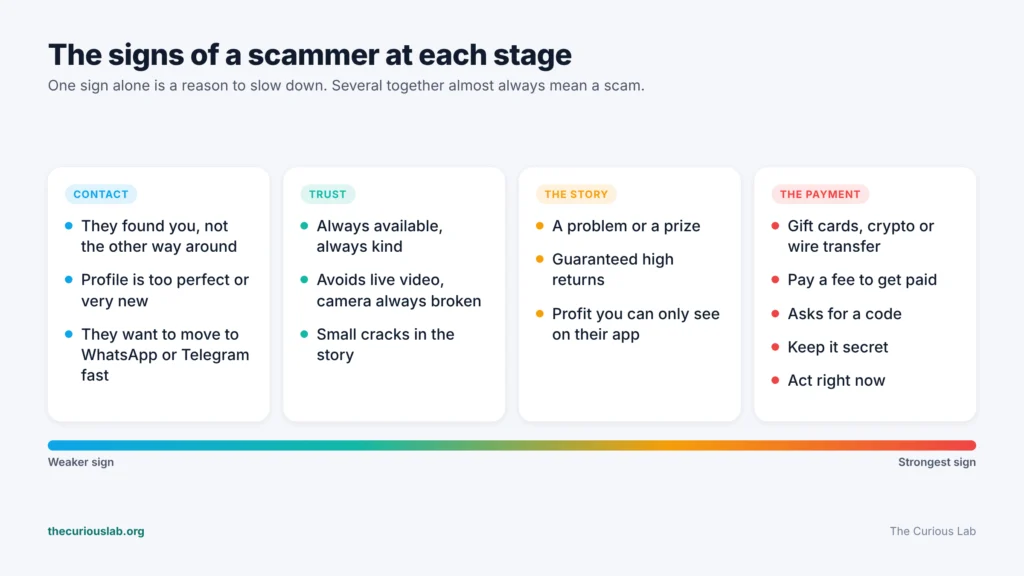
The signs of a scammer at each stage. The further along the script, the stronger the sign.
Signs at the contact stage
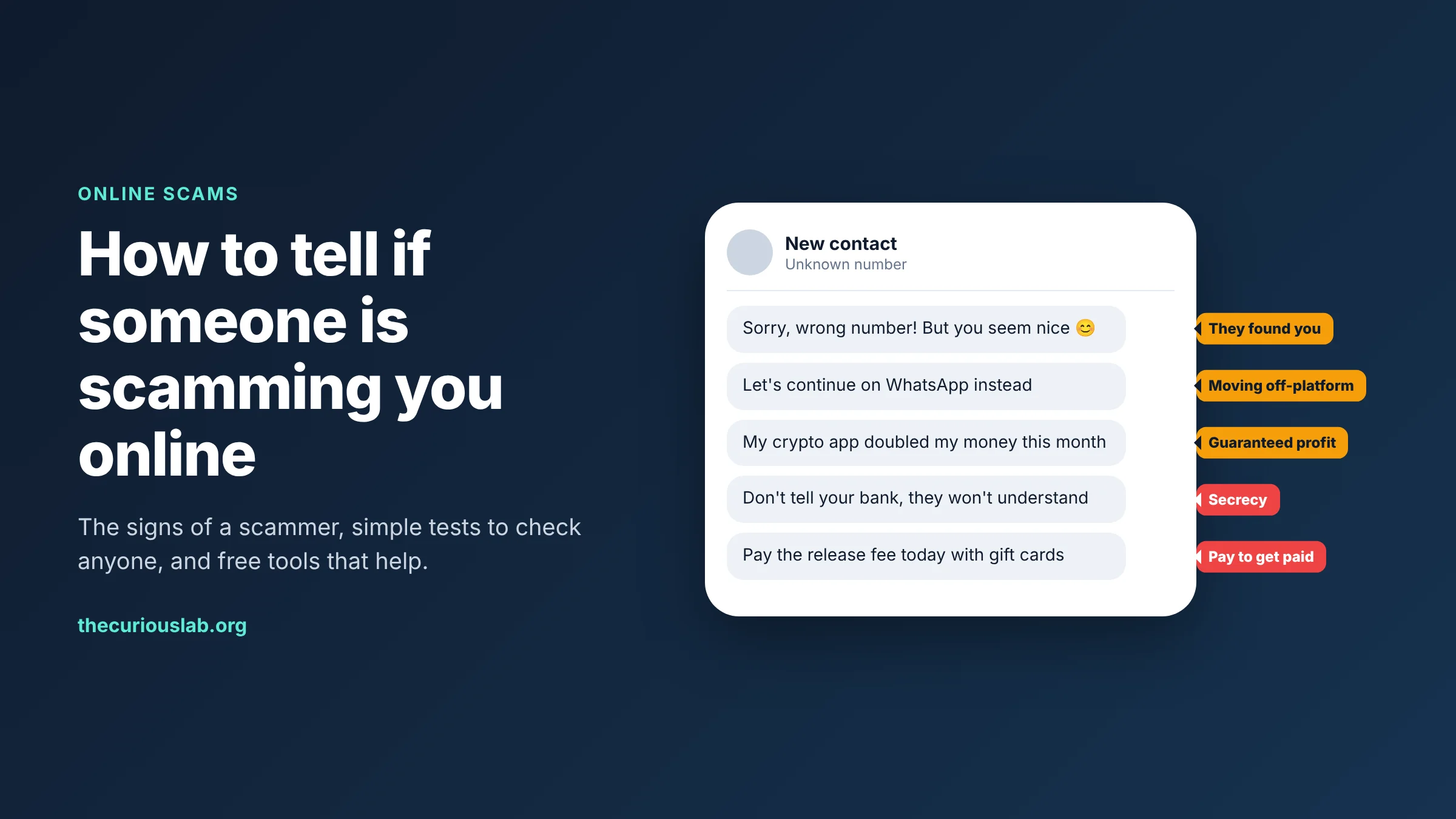
They found you, not the other way around. You didn’t apply for the job, enter the contest or post the item, but they say you did. Or a stranger sends a “wrong number” message, such as “Hi Anna, it was great meeting you yesterday,” and then stays friendly after you say you are not Anna.
The profile is too perfect or too new. Model-like photos, a very successful life, very few friends or posts, or an account created recently.
They want to move to another app quickly. A dating match or marketplace buyer asks you to continue on WhatsApp, Telegram, or text. The reason is simple: the platform you met on can watch for scams and ban accounts. A private app can’t.
Signs at the trust stage
They are always available and always kind. They message every morning and every night, remember every detail, and agree with everything. Note that the person may be a worker in a scam operation, following a script, which is why the attention never stops.
They avoid live video, or the video never quite works. There is always a reason: a broken camera, a poor connection, a job on an oil rig, a military posting. A live, unplanned video call is one of the hardest things to fake for long, so scammers avoid it.
Their story has small cracks. The job title changes, the city changes, the time zone doesn’t match, or their photos show up under another name. Scammers manage many conversations at once, so details slip.
Signs at the story stage
There is a problem or a prize. Your account is locked, you owe a fine, a relative is in trouble, a package can’t be delivered, or you have been chosen for a reward, a job, or an investment that “only a few people know about.”
The returns are guaranteed. Real investments never promise fixed, high profits with no risk. A person who says you “can’t lose” is the biggest sign of investment fraud.
You can see the profit, but only on their platform. You “earn” on an app or website they recommended, and the numbers go up fast. In many cases, you are even allowed to withdraw a small amount at first. This builds trust. The larger amount never comes out.
Signs at the payment stage
These are the strongest signs of all, because this is where the scammer finally has to ask.
They tell you how to pay, and it can’t be reversed. The FTC warns that scammers often insist on cryptocurrency, a wire transfer through a company like Western Union or MoneyGram, a payment app, or gift cards where you send them the numbers on the back. No real government office or company asks for payment in gift cards.
They need you to pay before you get paid. A fee to release your profits, a tax to withdraw, a deposit to unlock your job earnings, or a charge to claim a prize. Real earnings don’t need a payment from you to be released.
They ask for a code. A one-time code sent to your phone is the key to your account. Nobody who really works for your bank, a delivery company, or a website will ask you to read it out.
They ask you to keep it secret. “Don’t tell your bank, they will block it.” “Don’t tell your family yet, it’s a surprise.” Secrecy protects the scammer, not you. A real opportunity survives a second opinion.
They pressure you on time. The offer ends in an hour, the arrest happens today, the account closes tonight. The FTC says honest businesses give you time to decide, and anyone who pressures you to pay or give personal details is a scammer.
Which online scams are the most common, and what gives each one away?
Each common scam has its own costume, but each one also has one sign that gives it away. Knowing that sign is often enough.
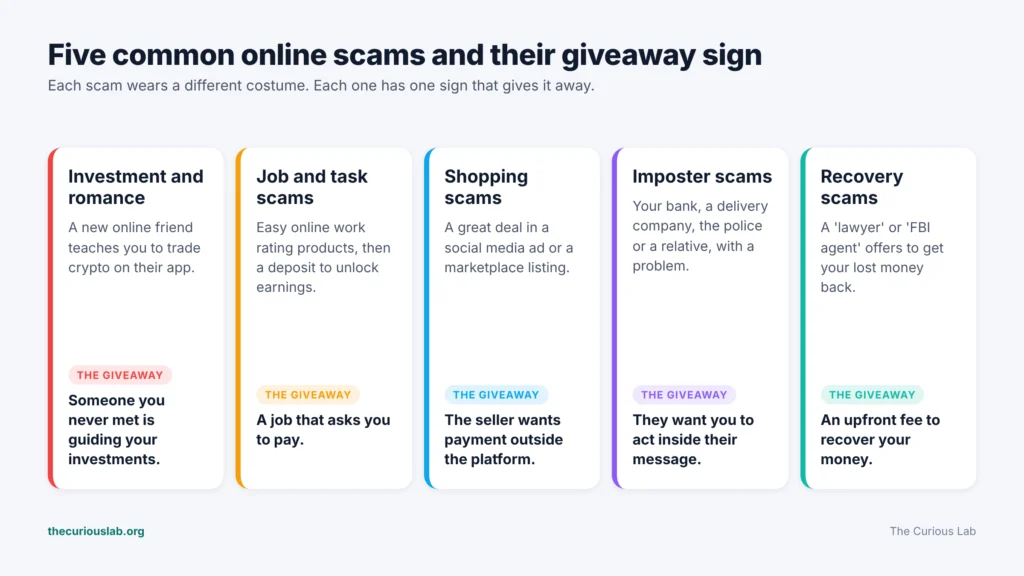
Five common online scams and the one sign that gives each one away.
Investment and romance scams (“pig butchering”)
This scam often starts as a friendship or a romance on social media, a dating app, or a “wrong number” text. After weeks of trust, the person mentions that they make money trading crypto and offers to teach you. You install the app they suggest and watch your balance grow.
The FTC says nearly 60% of people who lost money to a romance scam in 2025 said it started on social media, and investment scams that started on social media took $1.1 billion.
The name “pig butchering” comes from the idea of fattening a pig before the slaughter. The scammer “fattens” the victim with trust and fake profits before taking everything.
The sign that gives it away: someone you have never met in person is guiding your investment decisions. The FTC’s advice is direct: never let someone you met only on social media direct your investments.
Job and task scams
A message arrives on text or WhatsApp about easy online work, with few details. The “job” is to rate products, like videos or “optimize apps” on a website. At first, you even get small payments. Then a “combination task” appears that needs you to deposit money, usually in crypto, to unlock your earnings.
According to the FTC, reports of these task scams went from zero in 2020 to about 5,000 in 2023, and then to about 20,000 in just the first half of 2024. Reported losses to job scams overall grew from $90 million in 2020 to $501 million in 2024.
The sign that gives it away: a job that asks you to pay. A real employer pays you. You never pay an employer to work.
Shopping scams
You see a good deal in a social media ad or a marketplace listing: shoes, a phone, concert tickets, a car or a puppy. The seller wants a bank transfer or a payment app instead of the platform’s checkout. Then nothing arrives.
Shopping scams were the most reported type of social media scam in 2025, according to the FTC, and more than 40% of people who lost money to a social media scam said they ordered something they saw in an ad.
The sign that gives it away: the seller wants you to pay outside the platform, with a method that has no buyer protection.
Imposter scams
The message or call seems to come from your bank, a delivery company, the tax office, the police, Amazon, Microsoft, or a family member. There is a problem, and you need to act right now. We covered the voice and video version of this in our post on AI cyber attacks, and the email version in our post on what is phishing.
Note that scammers can change the name and number that appear on your caller ID, so a call that shows your bank’s real number can still be fake.
The sign that gives it away: they want you to act inside their message. A real organization is happy for you to hang up, open their official app or website yourself, and call them back.
Recovery scams: the second scam
This one targets people who have already lost money. Someone contacts them claiming to be a lawyer, a recovery company, or even the FBI’s Internet Crime Complaint Center (IC3), and promises to get the money back for a fee. The FBI has warned that these fake firms create forged documents and realistic websites, and sometimes know the exact details of the victim’s earlier losses. These details often come from leaked data that is traded on the dark web, which we explained in our post on dark web basics.
The sign that gives it away: anyone who contacts you out of the blue offering to recover your money for an upfront fee. The FBI advises never trusting these unsolicited offers. Real law enforcement doesn’t need you to pay to investigate a crime.
Simple tests to check if someone is real
When you are not sure, don’t argue with your feelings. Run a test. Each of these takes a few minutes, and none of them needs technical skills.
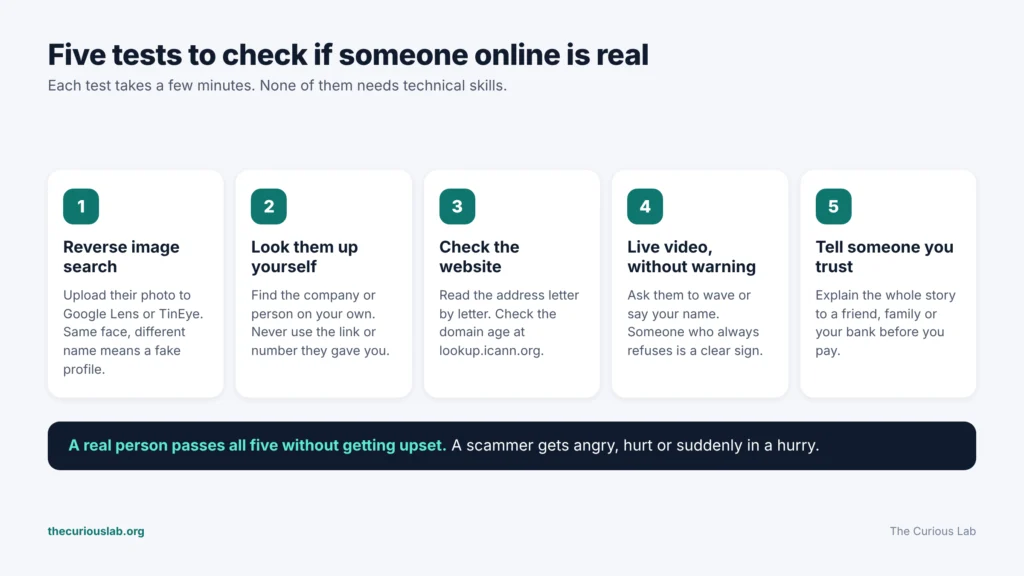
Five tests you can run on anyone you met online. A real person passes all of them easily.
Test 1: Reverse image search their photos. Save their profile photo and upload it to Google Lens or TinEye. If the same face appears under a different name, on a model’s page or on a stock photo website, the profile is fake.
Test 2: Look them up yourself. Don’t use the link, phone number, or website they gave you. Search for the company, recruiter, or seller on your own. Find the official website and contact them from there. Say, for example, a recruiter from a well-known company messages you. Call that company’s main number and ask whether the person works there.
Test 3: Check the website before you trust it. Look at the exact web address, letter by letter. Then check how old the domain is with ICANN Lookup (lookup.icann.org). A “global trading platform” or a “big online store” whose website was registered a few weeks ago is a strong warning sign. We explain the free tools for this in the next section.
Test 4: Ask for a live video call, without warning. Not a recorded video and not a photo. A live call, at a time you choose, where you ask them to do something simple, such as wave or say your name. A real person does this easily. Note that AI can now fake faces on video, so a successful call is not full proof, but a person who always refuses is a very clear sign.
Test 5: Tell someone you trust. Explain the whole story to a friend, a family member, or your bank before you send anything. The FTC recommends this too, because talking it through often makes the scam obvious. If the person you met online asked you to keep it secret, this test matters even more.
Remember, a real person or a real business passes all five tests without getting upset. A scammer gets angry, hurt, or suddenly in a hurry.
Free tools that help you check scam risk
No tool can tell you with full certainty whether a person is honest. But these free tools help you check the scam risk of a profile, a website, or a payment request in a few minutes.
| What you want to check | Tool | What it tells you |
| A profile photo | Google Lens, TinEye | Whether the photo is used elsewhere under another name |
| A website’s age | ICANN Lookup (lookup.icann.org) | When the domain was registered and by which registrar |
| A link before you click | Google Safe Browsing site status, VirusTotal | Whether the website is already known to be dangerous |
| An investment adviser | FINRA BrokerCheck and SEC Investor.gov (US), FCA Register (UK) | Whether the person or firm is licensed to give investment advice |
| A leaked email address | Have I Been Pwned | Whether your email appeared in a data breach, which scammers use for targeting |
| A crypto address | Wallet Safety Checker from The Curious Lab | Whether the address is on scam or sanctions lists, without connecting a wallet |
| An email sender’s domain | Link Safety Checker from The Curious Lab | Whether someone can send fake emails that look like they come from that domain |
| Your own accounts | Password Generator from The Curious Lab, plus a password manager | A strong, unique password, so one leak doesn’t open every account |
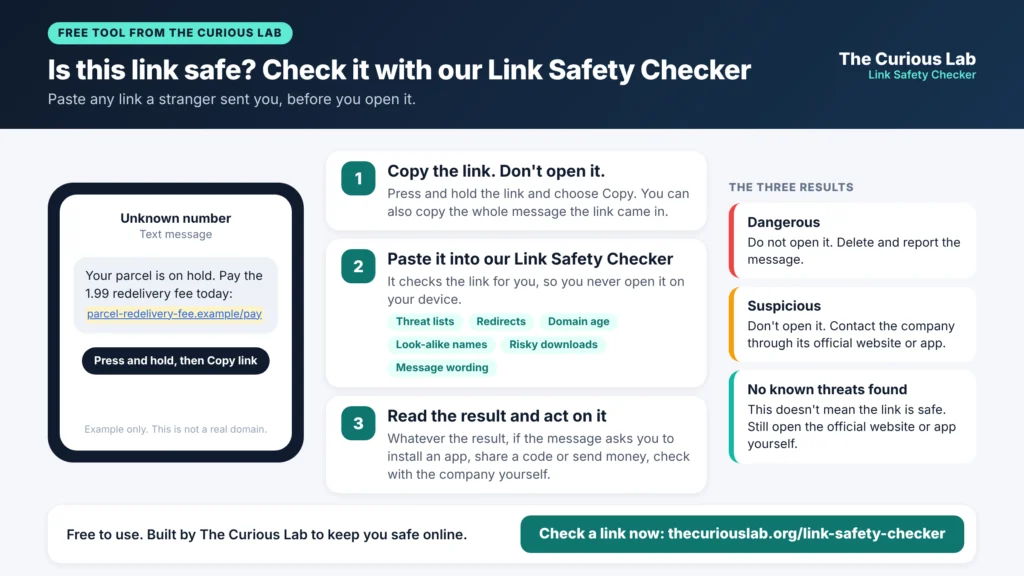
Three free checks before you open any link a stranger sent you.
Our Wallet Safety Checker is useful before you send crypto to anyone. You paste the public address, and the tool checks it against scam lists and the US sanctions list. You never connect your wallet or sign anything. Note that a good result doesn’t prove an address is safe, because scam lists are never complete. A bad result, though, is a clear reason to stop.
A note on “scam checker” websites that give a trust score: they can be a useful hint, but scammers create new websites faster than any list can be updated. So a good score on a brand new website means very little. The domain age and the payment method usually tell you more.
How to avoid online scams: fraud prevention tips for every day
Spotting a scam in the moment is good. Making yourself a harder target is even better. These fraud prevention tips stop many scripts at the contact stage, before they start.
- Don’t reply to unexpected messages from strangers, including “wrong number” texts. Replying confirms that your number is active.
- Keep your social media private. The FTC advises limiting who can see your posts and your contacts. Scammers use public details to build trust.
- Stay on the platform. Buy, sell, and chat inside the marketplace or dating app where you met. Their protection only works there.
- Never pay with gift cards, crypto, or wire transfers to someone you met online. Use payment methods with buyer protection, such as a credit card through a real checkout.
- Never share a one-time code with anyone, for any reason.
- Never install an app or give remote access because a stranger asked you to.
- Contact organizations yourself. Hang up, then call the number on your card or on the official website. Use your saved bookmark or the official app instead of a link in a message.
- Turn on two-step verification on your email, bank, and social media, so a stolen password alone is not enough. We explained how in our post on how to protect your home computer.
- Agree on a family rule: nobody sends money to someone they met online without talking to one other family member first.
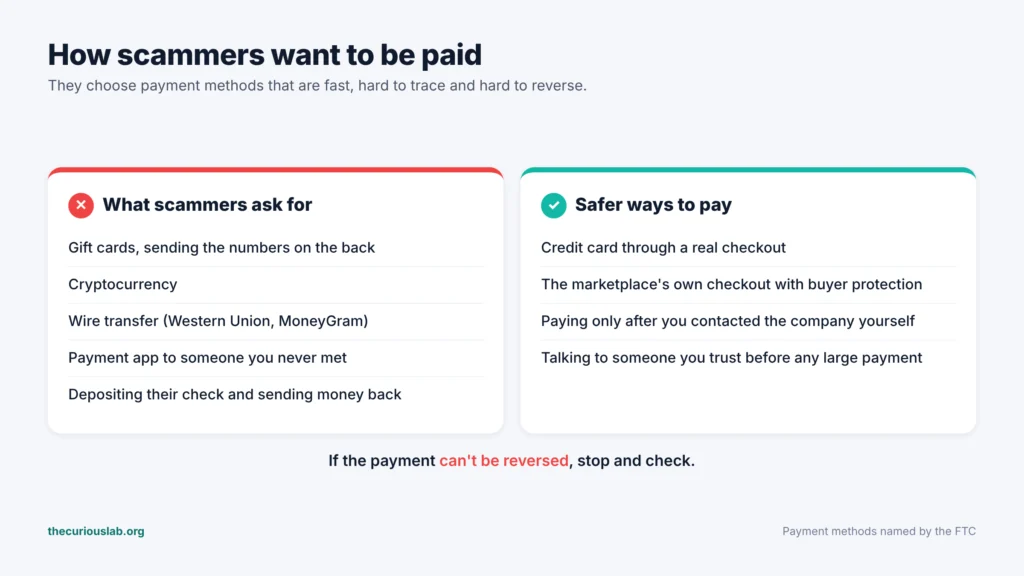
How scammers want to be paid, and why. If the payment can’t be reversed, stop and check.
What to do if you think you are being scammed
Don’t panic, and don’t keep it to yourself. The faster you act, the more you can protect.
- Stop all payments and contact. Don’t send “one last fee” to get your money back. Stop replying, and don’t let them talk you out of it.
- Call your bank or card company straight away. Use the number on your card. Banks can sometimes stop or recall a payment if you act quickly.
- If you paid in crypto, contact the exchange you used and report the receiving address. Save the transaction ID.
- If you shared a password or a code, change your passwords from a clean device, starting with your email, and sign out of all devices. If you installed an app or gave remote access, disconnect from the internet and follow the steps in our post on how to protect your home computer.
- Save the evidence. Screenshots of chats, profiles, websites, payment receipts, and phone numbers. Don’t delete the conversation.
- Report the profile to the platform where you met, so it can be removed before it reaches the next person.
- Report it to the authorities. In the US, report at ReportFraud.ftc.gov and ic3.gov. We listed where to report in the UK, India, Australia, Canada, and Singapore in our post on baiting.
- Beware of the second scam. After you report, you may be contacted by “recovery experts,” “lawyers,” or “FBI agents” offering to get your money back for a fee. That is a recovery scam. If someone claims to be from the FBI, hang up and call your local FBI field office using the number on fbi.gov.
Note that falling for a scam has nothing to do with being foolish. Scammers practice their scripts every day, on thousands of people. Reporting it helps the police and banks warn the next person.
A real story: the scam compounds behind the friendly messages
In October 2025, the US Department of Justice charged Chen Zhi, the founder and chairman of Cambodia’s Prince Holding Group, with wire fraud conspiracy and money laundering conspiracy. At the same time, it filed to seize about 127,271 bitcoin, worth around $15 billion, the largest forfeiture action in the department’s history.
According to prosecutors, Prince Group presented itself as a real estate and financial services business. Behind that, it ran scam compounds across Cambodia: large dormitories behind high walls and barbed wire, where trafficked workers were forced to run crypto investment scams on victims around the world, including in the United States. Many of these workers had been lured with fake job offers, and they were held under threats of violence. The US Treasury and the UK government also placed sanctions on the group.
This story changes how we should picture the “person” on the other side of the chat. The friendly stranger who texted you by mistake may be a worker in a compound, reading a script, under orders to reach the payment stage.
Basically, the scam is not personal, even when it feels personal. It is a business process. And a business process can be broken by one person who refuses to follow the next step of the script.
Final thoughts
Telling if someone is scamming you online is not about reading minds. The photo, the name, the website, and even the voice can be fake. The script can’t change much, because it always has to end with you sending money, a code, or access.
So watch the script. Notice who started the contact, how fast the trust grew, whether a problem or a prize appeared, and how they want to be paid. Run the five tests when you are unsure. Use the free tools to check the website, the photo, and the crypto address. And when anyone asks you to pay in a way that can’t be reversed, or to keep it secret, stop.
Note that you don’t need to remember everything in this post. Remember one rule: never send money, a code, or access to someone you have only met online until someone you trust has heard the whole story. That one rule breaks almost every script.
If you want to go beyond staying safe and learn cybersecurity step by step, see our cybersecurity roadmap.
We will update this post if we find new scam patterns worth knowing.
Stay safe, stay alert!
Related posts from The Curious Lab
- How to Prevent AI Cyber Attacks? A Simple Guide for Everyone
- What Is Baiting in Cybersecurity? How Do Attackers Get You to Hack Yourself?
- How Can You Protect Your Home Computer? A Simple Guide for Everyone
- What Is Phishing?
- Dark Web Basics: How to Access Links
- How Long Does It Take to Learn Cybersecurity? Cybersecurity Roadmap
Free tools from The Curious Lab
- Wallet Safety Checker: check a crypto address against scam and sanctions lists without connecting a wallet.
- Link Safety Checker: Paste a link, or the whole message, and we check it against trusted threat lists, follow where it really goes, and look for the tricks scammers use. You never have to open it.
- Password Generator: create a strong, random password in one click.