
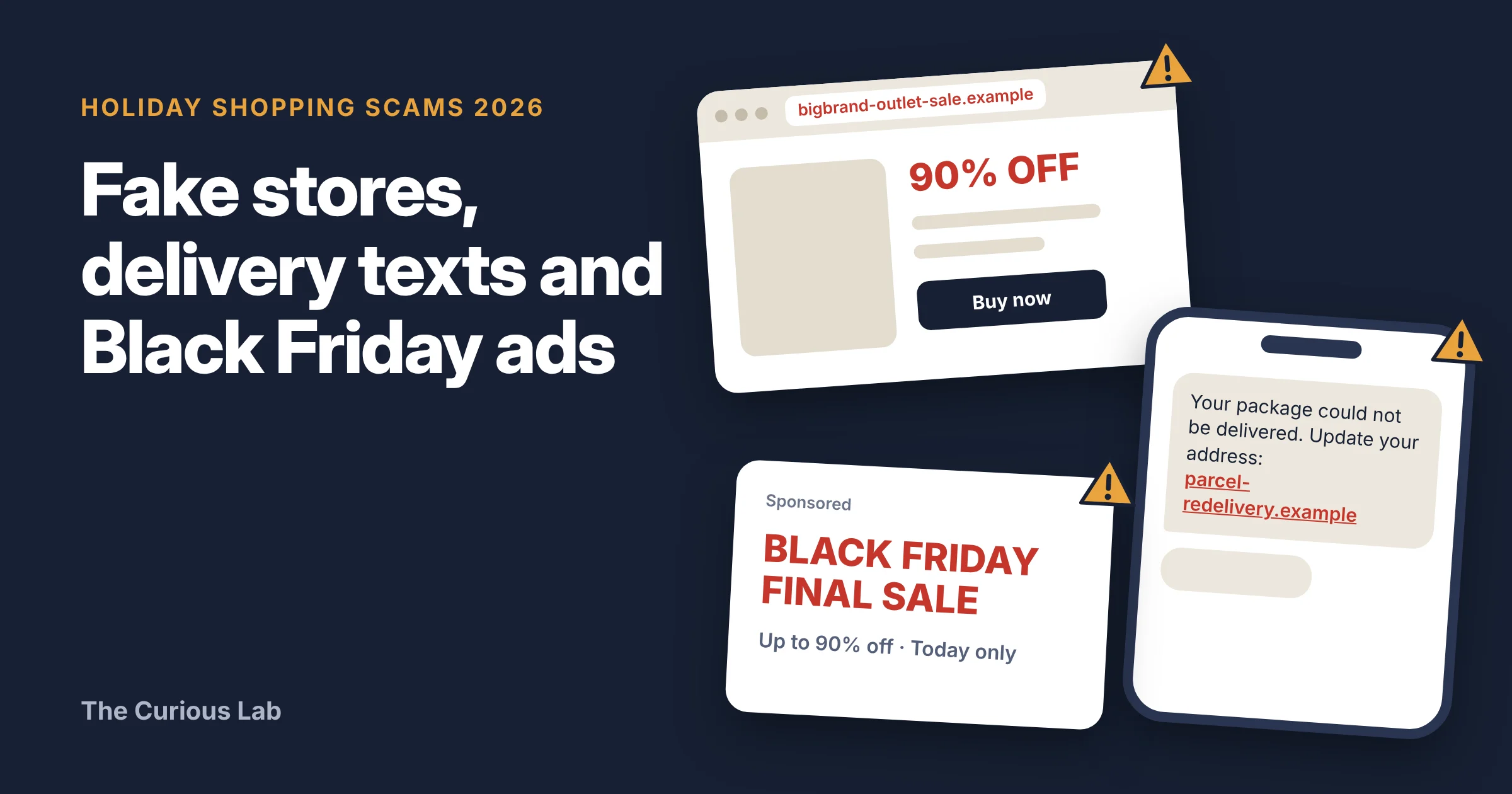
Shopping scams are more common, where a scammer creates a fake online e-commerce website and lists products at an insanely low price, which most buyers fall for.
As the holidays approach, November and December are the months when most of these scams happen.
Black Friday falls on November 27 this year, and Cyber Monday on November 30. The National Retail Federation (NRF) expects US holiday sales in November and Decem
ber to grow 4.2% to $1.013 trillion. More shopping means more targets.
In this post, we will look at the three most common holiday shopping scams of 2026: fake stores, Black Friday ads, etc. We will also see the signs of each one, the checks to run before you pay, and what to do if you have already paid.
Why do holiday shopping scams work so well?
People expect a bargain. If we see an ad for a 70% offer in March, we will be skeptical, or the ad will look suspicious to us. But on Black Friday, the same ad will look genuine. This is because most of the brands provide the biggest discounts during this period.
You will be in a hurry to buy. A fake label that says only 5 are left will make you rush to buy the product first.
We have made a post on how to tell if someone is scamming you; the holiday scam works in the same script, but the money flow here is faster.
You will click an ad that brings you to the fake store. You will make the payment to a fake store. Your money is lost. You will know only when the package has not arrived.
Here, the scammer works with your psychology.
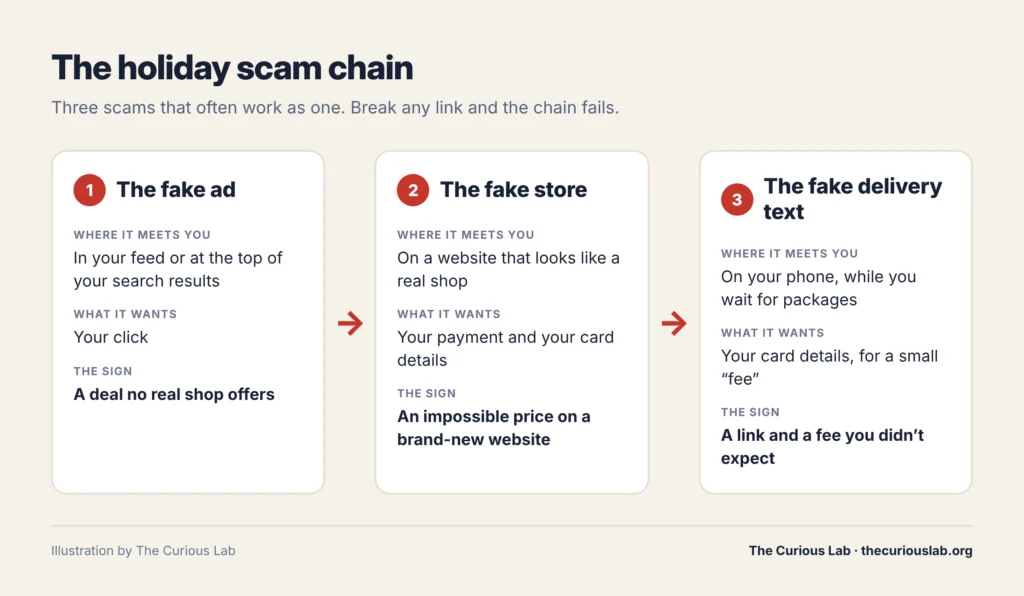
How do fake online stores work?
A fake online store will look like a real online store. The existence of the store is only to take away your money or to steal your credit card information.
While there is a myth that fake stores always look cheap, with bad spelling and blurry photos, it is wrong. AI tools now write the product pages and create the photos. We covered this in our post on how to prevent AI cyber attacks.
The numbers for 2026 show how large this has become. Scamwise, a free scam-checking tool from Savi Security, studied more than 250,000 shopping websites that people submitted between March and October 2026. It judged more than 100,000 of them to be scams. Here is what it found.
- About 500 new fake stores appear every day.
- 74% of the scam stores used AI-generated content.
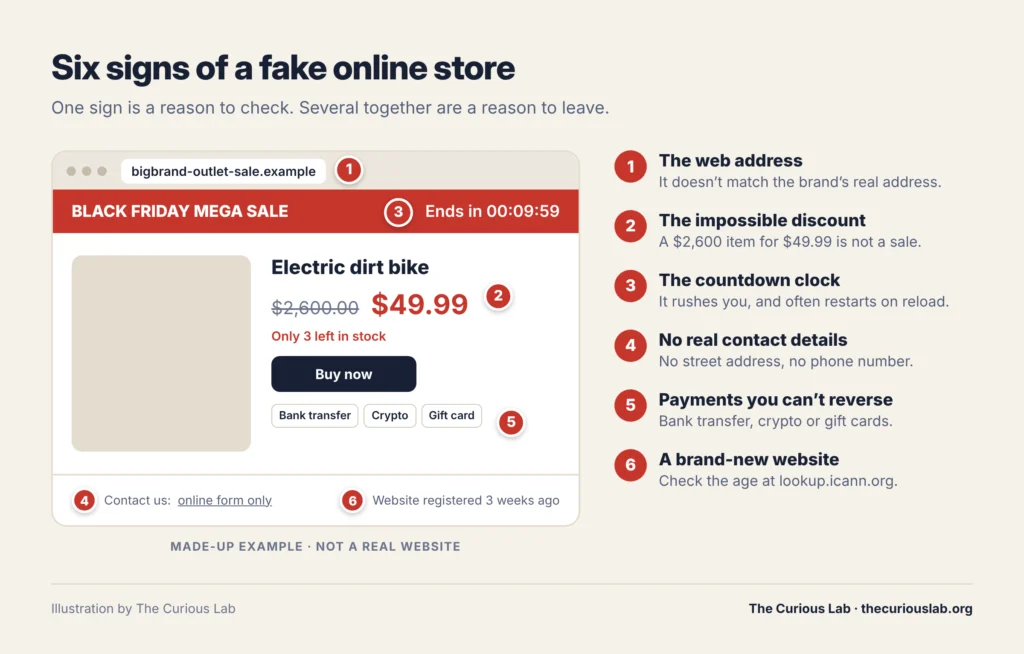
- 80% used an impossible discount or careless pricing. One store listed an electric dirt bike at $49.99, when the real price is about $2,600.
- More than half were hosted on well-known e-commerce platforms such as Shopify, Amazon, Etsy, and eBay. So, a trusted platform logo doesn’t prove that the seller is honest.
- 40% had a web address that was less than 90 days old.
- 7 in 10 were no longer online 90 days after they were checked.
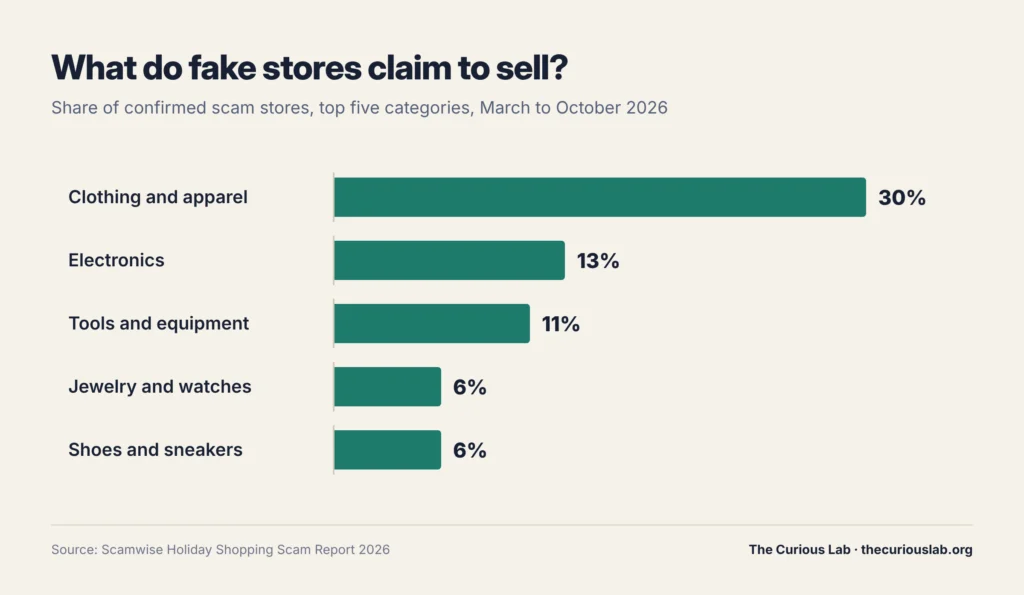
The top five categories of confirmed scam stores, March to October 2026. Source: Scamwise Holiday Shopping Scam Report 2026.
Scamwise also reported that holiday-themed fake stores grew fivefold in 60 days, and that the store that scams a Black Friday shopper most likely doesn’t exist yet.
Basically, fake stores are built to be thrown away. A list of “known scam websites” can’t keep up, so you have to check the store yourself.
What are the signs of a fake store?
The price is too low. Compare it with a retailer you already know. A real sale takes 20% or 40% off. It doesn’t sell a $2,600 item for $49.99.
The website is brand new. Check the age of the web address at ICANN Lookup (lookup.icann.org). A “big outlet” that was registered three weeks ago has no track record.
The web address doesn’t match the brand. Say, for example, “bigbrand-outlet-sale.example” instead of the brand’s real address. This is an example domain to illustrate the idea, and it is not a real domain.
There are no real contact details. No street address, no phone number, only a contact form.
It wants a payment you can’t reverse. A bank transfer, a payment app, crypto or gift cards.
It rushes you. A countdown clock that restarts when you reload the page is a clear sign.
How do fake Black Friday ads lead you to scams?
A fake store needs visitors, and this is done by creating ads and then promoting them on social media.
Here is the difference from a delivery text. In a delivery text scam, the attacker comes to you. In a fake ad, you go to the attacker. The ad waits in your feed or at the top of your search results, and you take the action. It is the same idea we saw in our post on baiting.
Scamwise traced at least 1 in 5 fake stores back to an ad on a major platform. Among those clicks, search ads and Meta (Facebook and Instagram) led the way.
Where the ads behind fake stores ran, among fake stores traced to an ad. Source: Scamwise Holiday Shopping Scam Report 2026.
The US Federal Trade Commission (FTC) saw the same pattern. Shopping scams were the most reported type of social media scam in 2025, and more than 40% of people who lost money to a social media scam said they ordered something they saw in an ad.
Note that an ad on a big platform is not a recommendation from that platform. Anyone can pay for an ad. The “Sponsored” label means someone paid. It doesn’t mean someone checked.
The common stories in fake ads are a “store closing” sale, a “final close-out”, a famous face praising the product, and a well-known brand at a price no real shop offers.
So, treat every ad as a stranger. Do not click it. Search for the store yourself, or type the brand’s address into your browser. The FTC also advises searching for the seller’s name and website address together with words such as “review”, “complaint,” or “scam”.
How to protect yourself from holiday shopping scams?
Here are the three scams side by side.
| Fake store | Black Friday ad | Delivery text | |
| How it reaches you | You land on it | It waits in your feed or search results | It arrives on your phone |
| What it wants | Your payment and card details | Your click | Your card details |
| The sign that gives it away | An impossible price on a brand-new website | A deal no real shop offers | A link and a fee you didn’t expect |
| What to do | Check the store before you pay | Search for the store yourself | Track the package yourself |
And here are the checks to run before you pay.
- Never let an ad or a text take you to the checkout. Type the store’s address yourself.
- Search the store’s name with the word “scam” or “reviews”.
- Check how old the website is.
- Compare the price with a retailer you know.
- Pay with a credit card. The FTC says a credit card payment is protected by law, so you can dispute a charge for something that never arrived.
- Never pay an unknown store by bank transfer, crypto, or gift cards.
- Use a different password for every store account. You can create one with our free Password Generator.
- Read your card statements every week until the end of January.
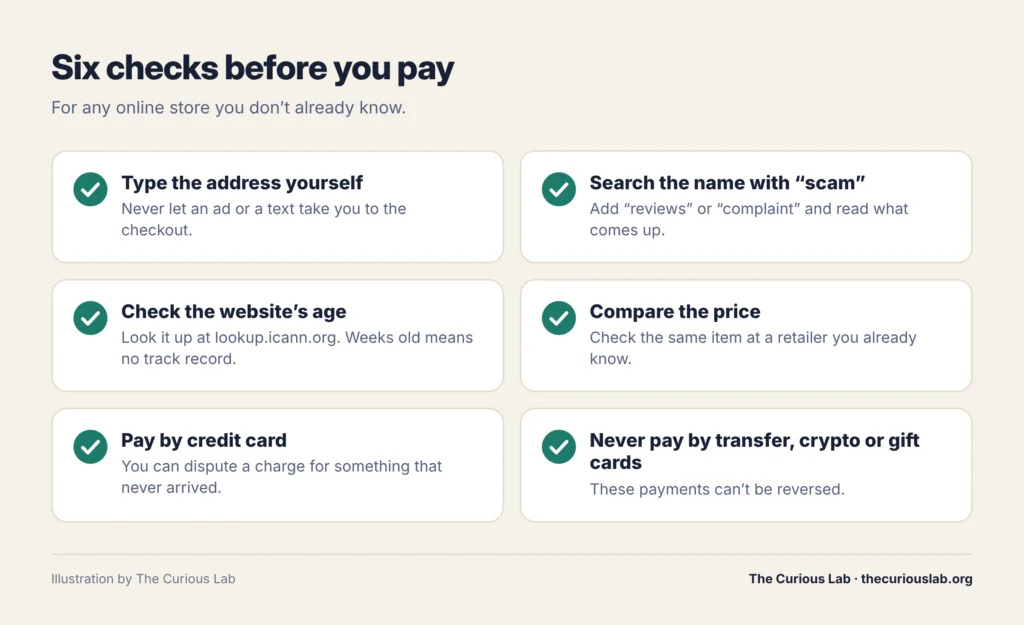
Six checks to run before you pay an online store you don’t know.
What to do if you already paid a fake store?
Don’t panic. The faster you act, the more you can protect.
- Call your bank or card company. Use the number on your card. Ask to dispute the charge. In the US, the time limit is 60 days from the first statement that shows it.
- Ask for a new card if you typed your card number into a page you no longer trust. The Postal Inspection Service advises telling your bank even if you didn’t press “submit”.
- Change your password if you created an account on the fake store and use the same password elsewhere.
- Save the evidence. The ad, the web address, the order email, the text, and the receipt.
- Report it at ReportFraud.ftc.gov and ic3.gov. We listed where to report in other countries in our post on baiting.
- Watch for identity theft if you shared more than your card. We explained the signs in our post on what is identity theft, and the steps that block it in our post on how to prevent identity theft and freeze your credit.
Final thoughts
Holiday shopping scams are the most common scam that people fall for. But we can completely avoid them by not trusting any website or store blindly. Always be suspicious of any store online; this will help you protect your money.
Note that you don’t need to remember everything in this post. Remember one rule: never let an ad or a text choose where you shop or where you pay. Go to the store or the delivery company yourself. That one rule breaks all three scams.
We will update this post if we find new holiday scam patterns worth knowing.
Stay safe, stay alert!